
 EN
How to Select Reliable Garden Equipment Suppliers for Global Markets?
Choosing a garden equipment supplier for an international program is not simply a matter of comparing unit prices. A low quoted price can become expensive when documentation is incomplete, product specifications drift between batches, or spare parts are unavailable in season. For distributors, importers, and private-label teams, the useful question is: can this supplier repeatedly deliver the right equipment, evidence, and support for your destination market?
This guide starts with verification rather than a supplier’s sales presentation. It applies whether you are assessing a garden machinery manufacturer, an OEM partner, or a source of wholesale equipment for mowers, tillers, shredders, water pumps, or cordless tools.
Start with your market and product brief
Before you compare suppliers, document what you need to sell. Define the product categories, target customer, expected annual volume, retail or professional positioning, preferred power source, packaging languages, warranty expectations, and target markets. A reliable garden equipment supplier should be evaluated against this brief rather than against a generic catalogue.
Market conditions matter. European buyers may need to validate machinery safety, noise, emissions, labelling, and technical-documentation requirements. Cordless equipment introduces another layer: the actual battery and product model should be tied to transport documentation, including a UN 38.3 test summary when applicable. In Latin American or rural markets, terrain, fuel quality, climate, and service coverage may change the specification priorities. Ask suppliers to identify the assumptions behind their proposed configuration.
Confirm what kind of supplier you are dealing with
The terms manufacturer, trading company, distributor, and OEM are often used loosely. They describe different levels of control, so verify them early. A factory may control engineering, assembly, testing, and packaging. A trading company may coordinate several factories. Either model can work, but the buyer needs clarity about who owns specifications, who issues documents, and who is accountable when an issue occurs.
- Request the legal entity name, production address, export contact, and the plant responsible for each product family.
- Ask which operations are in-house and which are outsourced, including engines, batteries, motors, decks, packaging, and final inspection.
- For an OEM program, define ownership of artwork, tooling, packaging files, technical changes, and private-label documentation before development begins.
- Use a live video audit or third-party visit to verify the production flow, test stations, warehouse controls, and traceability methods.
The useful answer is usually specific. It explains who does what and identifies any supplier-managed component. Broad assurances without a process map are less useful than a concise, verifiable description.
 Supplier verification should connect the product brief to traceable evidence.
Evaluate engineering and specification control
For powered garden equipment, a quotation is only the start. Build a specification sheet that names the model, revision, key components, performance claims, safety features, carton contents, labels, manuals, and approved samples. Then ask how the supplier prevents an unapproved substitution after the sample stage.
Focus on the failure points that affect your channel. For a lawn mower, that may include deck durability, starting performance, cutting configuration, and service parts. For shredders, it can include feed capacity, safety interlocks, noise performance, and jam-clearing procedures. For cordless products, ask about battery compatibility, charger configuration, model-specific documentation, and spare-battery logistics. The answer depends on the product and market, but each feature should connect to a written specification and a test method.
Make compliance evidence a purchase gate
Compliance is not a file to request after production. Ask a garden equipment supplier to provide a document matrix for every target market and SKU: applicable standards or regulations, declarations, test reports, manual languages, labels, and the responsible economic operator. Review the documents against the actual model and configuration, not merely a similar product.
For EU-bound machinery, confirm the current requirements with qualified local compliance support and determine who maintains the technical documentation and Declaration of Conformity. For battery-powered tools, request the relevant battery transport evidence and check that model identifiers match the cells, battery pack, and finished product being shipped. A supplier that can explain gaps and a corrective plan is easier to assess than one that simply sends a folder of unlabeled PDFs.
Turn quality inspection into a written control plan
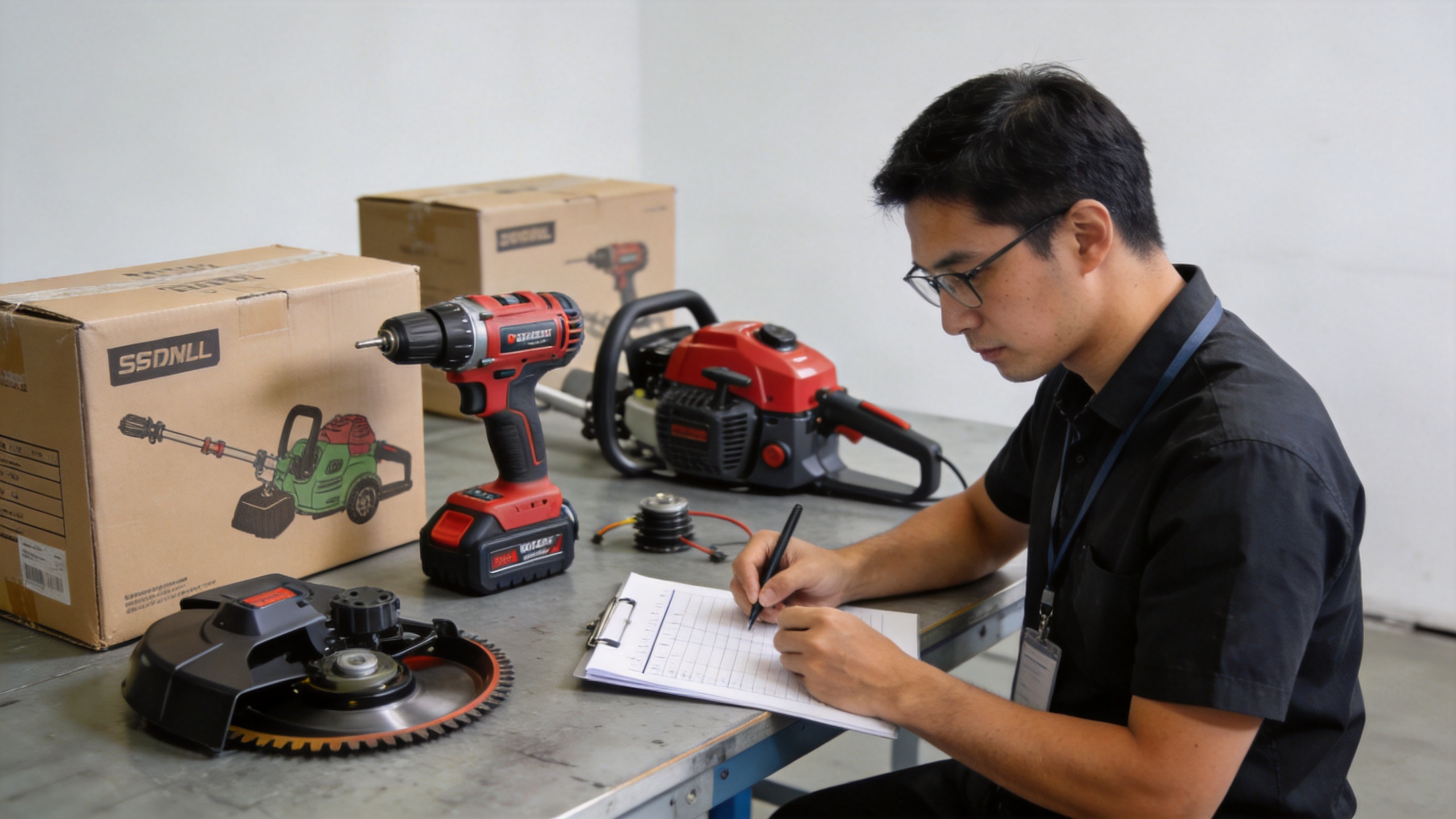
A stated commitment to quality inspection is not enough. Convert it into a control plan that both parties sign before the purchase order. The plan should define the approved sample, inspection timing, inspection level, defect categories, acceptance criteria, functional tests, packaging checks, and the action required when a lot does not meet the agreed standard.
- Pre-production: approve the bill of materials, artwork, labels, manuals, and golden sample.
- During production: check critical dimensions, assembly points, safety components, and corrective actions before the full lot is complete.
- Pre-shipment: verify quantity, appearance, functional performance, cartons, labels, documents, and loading condition against the agreed checklist.
- After arrival: record defects by batch and share structured feedback so recurring issues drive a documented change.
Do not copy an acceptance level from another program without reviewing the product risk. Blade guards, electrical safety, fuel leakage, battery damage, and missing warnings need different treatment from minor cosmetic marks. If a supplier offers pre-shipment inspection, ask to see the report format and learn whether an independent inspection can be witnessed or commissioned.
Test service readiness before scaling wholesale equipment
Garden machinery is a seasonal category. A supplier relationship that functions during sampling but stalls when a replacement blade, battery, starter component, or manual is needed can damage a distributor’s reputation. Evaluate after-sales capability alongside production capacity.
- Request a spare-parts list with part numbers, drawings or photos, lead-time expectations, and minimum order terms.
- Ask how warranty claims are diagnosed, approved, tracked, and closed.
- Clarify which parts are stocked, which are made to order, and how long the supplier plans to support the model.
- Check whether technical questions can be answered in a language and time zone workable for your team.
For a first order, run a small service test: request a parts quotation, an exploded view, and a troubleshooting response. That small request reveals a great deal about the operational side of a garden equipment supplier before seasonal volume is committed.
Compare commercial terms beyond the unit price
Create a weighted supplier scorecard instead of choosing on price alone. Include delivered cost, product readiness, documentation quality, inspection results, lead-time reliability, MOQ flexibility, payment exposure, parts support, communication, and responsiveness to corrective actions. The weights should reflect your channel; a private-label retailer may assign more weight to packaging and compliance, while a professional-equipment distributor may prioritize durability and parts availability.
Also test how the supplier handles change. Ask what happens if carton language changes, a component becomes unavailable, demand increases, or a nonconformance is found before shipment. A well-managed manufacturer or OEM will identify approval steps, timing, costs, and responsibility rather than promising that every request is simple.
Use a staged supplier-approval process
A reliable global sourcing decision is built in stages: shortlist, document review, sample evaluation, factory or remote audit, pilot order, inspection review, and controlled scale-up. Keep approval conditional until the supplier has met the agreed evidence and quality checkpoints. This approach may take longer than picking the lowest quotation, but it leaves buyers with a clearer record of why the supplier was chosen and what still needs monitoring.
The right garden equipment supplier is the one whose capabilities, documents, quality controls, and service model fit your specific market plan. Ask for evidence, turn promises into measurable requirements, and use the first order to validate the relationship before expanding your wholesale equipment program.


 Hot News