EN
Why Are Ride On Mowers Suitable for Large Scale Lawn Management?
A large lawn is not just a bigger version of a small garden. Long passes, transport between areas, repeated cutting and the time spent emptying clippings all shape the work. A ride on mower can make that work more manageable because the operator travels with the machine while a cutting deck handles each pass. The advantage is conditional: access, slopes, obstacles and the required finish still determine whether a particular machine suits the site.
For a grounds manager or a landscaping service, the question is not simply how fast a mower moves. It is how much useful work a crew can finish safely within a maintenance window, including preparation, trimming and routine servicing. Looking at the whole job gives a clearer picture of efficiency than a headline cutting width alone.
How the working pattern changes on a large site
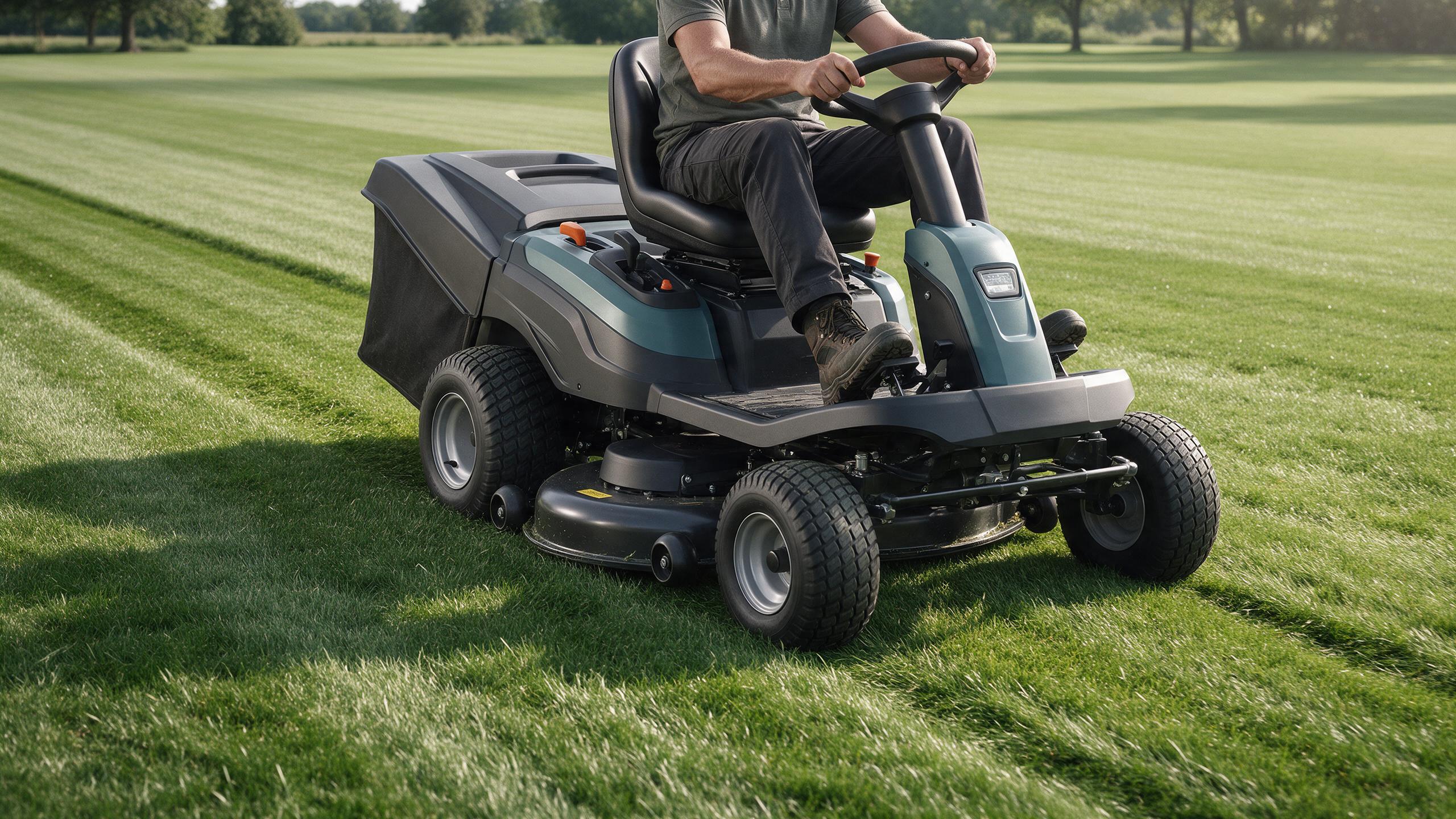
A ride on mower lets an operator remain seated while crossing long open sections. A deck that covers more width than a smaller walk-behind unit can reduce the number of passes needed on an unobstructed lawn. That does not translate directly into the same percentage of time saved: turns, overlap, travel between plots and interruptions all consume time. Wet or dense growth may also call for a slower pace to maintain an even result.
Consider two hypothetical sites of equal area. One is an open field with a wide gate; the other has narrow entrances, trees and small islands. The first offers long, uninterrupted runs. On the second, a large deck may require extra manoeuvres and leave edges for another tool. Compare the completed job, not just the distance travelled on the open portion.
For large area mowing, measure the accessible cutting area separately from paths, planting beds and water features. Then note how often it needs cutting and whether the operator must remove clippings. These observations help define the actual workload before comparing specifications.
Deck width and site access must work together
Deck width affects the width of each cut, but a wider deck is useful only if it can enter and turn within the area. Check the narrowest gate, passage and storage doorway, and allow room for the full machine rather than the deck alone. Ask the supplier for overall dimensions and check how discharge chutes or collection attachments alter clearance.
A ride on mower with a smaller deck can be a practical choice on a fragmented property, even where the total area is substantial. If the fleet maintains open sports surrounds and a separate collection of confined courtyards, two different tools may suit the work better than one oversized machine. Plan for a trimmer or walk-behind unit where obstacles or boundaries leave an unfinished strip.
Cutting height adjustment also matters. Seasonal growth, turf species and site expectations affect the height chosen; the machine needs an appropriate range and a clear adjustment method. University of Arkansas extension guidance recommends removing no more than one-third of the leaf height in a single cut. A regular schedule makes this easier to follow than waiting until growth is excessive and trying to finish in one pass.
Clipping handling can reshape the schedule
Collection, side discharge and mulching are different operating choices, and their availability depends on the machine. Collection can leave a tidy surface, but it adds stops to empty the collector and a separate disposal task. Discharge avoids collection stops where the site permits clippings to remain, while mulching works by recutting and returning material to the lawn. The finish depends on conditions and the equipment used.
For commercial lawn care, ask who will empty collected material, where it will go and whether transport is needed. Frequent stops may offset the benefit of a wider deck. When growth is long or damp, check the operator instructions and adjust the schedule or cutting approach rather than assuming any discharge mode will give the same result in every condition.
Some jobs call for collection near buildings and a different approach on open ground. Verify that the selected ride on mower supports the required configuration and that changing it fits the crew's workflow. Do not assume accessories are included or interchangeable across models.
Comfort supports control, not unlimited working time
Sitting rather than walking behind the machine can reduce the distance an operator has to walk over a large lawn. Seat adjustment, visibility, controls and access to the platform all influence whether that arrangement is practical for the people who will use it. During a demonstration, check whether each operator can reach the controls comfortably and see the work area without awkward movement.
A ride on mower still requires attention and planned breaks. Bumps, vibration, heat and repeated turns can make long sessions tiring. Operators should follow the manual, use appropriate protective equipment and stop if conditions or fatigue make safe control uncertain. Comfort features do not replace training or safe operating procedures.
Terrain and safety set the boundaries
Before selecting a ride on mower, walk the site and identify slopes, soft ground, holes, drop-offs, water edges, loose objects and areas used by the public. Consult the exact machine's manual for slope limits, mowing direction and other restrictions. Avoid mowing slopes or conditions outside those limits; use another suitable maintenance method instead. A machine's ability to move up a bank does not establish that it is safe to cut there.
Clear the cutting area of debris and keep bystanders outside the operating zone. Stop the machine and follow its shutdown procedure before clearing a blockage, inspecting the deck or carrying out maintenance. Keep guards and safety interlocks in place and working. These checks take time, but they belong in a realistic large area mowing plan.
Compare the full cost of a working season
The purchase price is only one part of the decision. For a landscaping service, the cost of a ride on mower also includes energy or fuel, routine service, blades, tyres, transport, storage and any attachments. Service access and local replacement parts matter when a machine must return to work during a busy period. Ask what maintenance is required at the expected usage level and who can provide it nearby.
Record the time a crew spends travelling, cutting, emptying, trimming and cleaning on a representative job. Then compare those observations with a supervised demonstration of the proposed machine under similar conditions. This is a practical way to assess efficiency without relying on an advertised coverage figure that may not include obstacles or downtime.
A concise selection checklist
- Map open areas, narrow access points, obstacles and places that need separate trimming.
- Compare deck width with both the working area and the narrowest access route.
- Check the manual's terrain limits and choose another method for unsuitable ground.
- Confirm the available clipping options, accessories and emptying arrangements.
- Evaluate operator fit, transport, storage, maintenance and parts support.
- Compare total job time and expected operating costs using a representative site.
A ride on mower is most useful when its size, cutting system and service arrangements match the actual site. For open, regularly maintained lawns it can reduce walking and make repeated passes easier to organise. For confined or hazardous sections, a complementary tool may be the more sensible answer. The right choice for commercial lawn care is the one that lets the crew meet its schedule and finish requirements within the equipment's safe operating limits.
 Hot News