
 EN
What Are the Advantages of Four Wheel Drive Lawn Mowers?
A four-wheel-drive system can make a gasoline lawn mower far easier to manage when a lawn is uneven, damp, or interrupted by rough patches. It does not turn every machine into a slope mower, and it does not replace careful operation. What it does provide is more consistent propulsion at the wheels that still have grip. For landscaping teams, dealers, and property owners, that difference can mean fewer stalled passes, less physical effort, and more predictable mowing on demanding ground.
From a contractor’s viewpoint, the value is simple: a gasoline lawn mower should keep moving at a controlled pace while the operator concentrates on the cutting path. Four-wheel drive is most useful where a two-wheel-drive mower would repeatedly spin, drift, or ask the user to push harder.
How four-wheel drive changes traction
A conventional self-propelled gasoline lawn mower commonly drives one axle. When those driven wheels lose contact or meet a slippery patch, propulsion can drop even if the engine and blade are working normally. A four-wheel-drive gasoline lawn mower distributes driving force to both axles. That creates more usable contact points, so a wheel that begins to slip is less likely to stop the entire machine’s forward progress.
This wheel drive layout is especially helpful on ground with small ruts, exposed roots, loose soil, thick turf, or patches that remain damp after rain. Instead of needing a burst of pushing force at each difficult section, the operator can maintain a steadier walk and let the drive system assist. The result is not merely faster travel; it can also help the blade deck move through the lawn at a more even pace, which supports a more uniform cut.
Better terrain ability for uneven properties
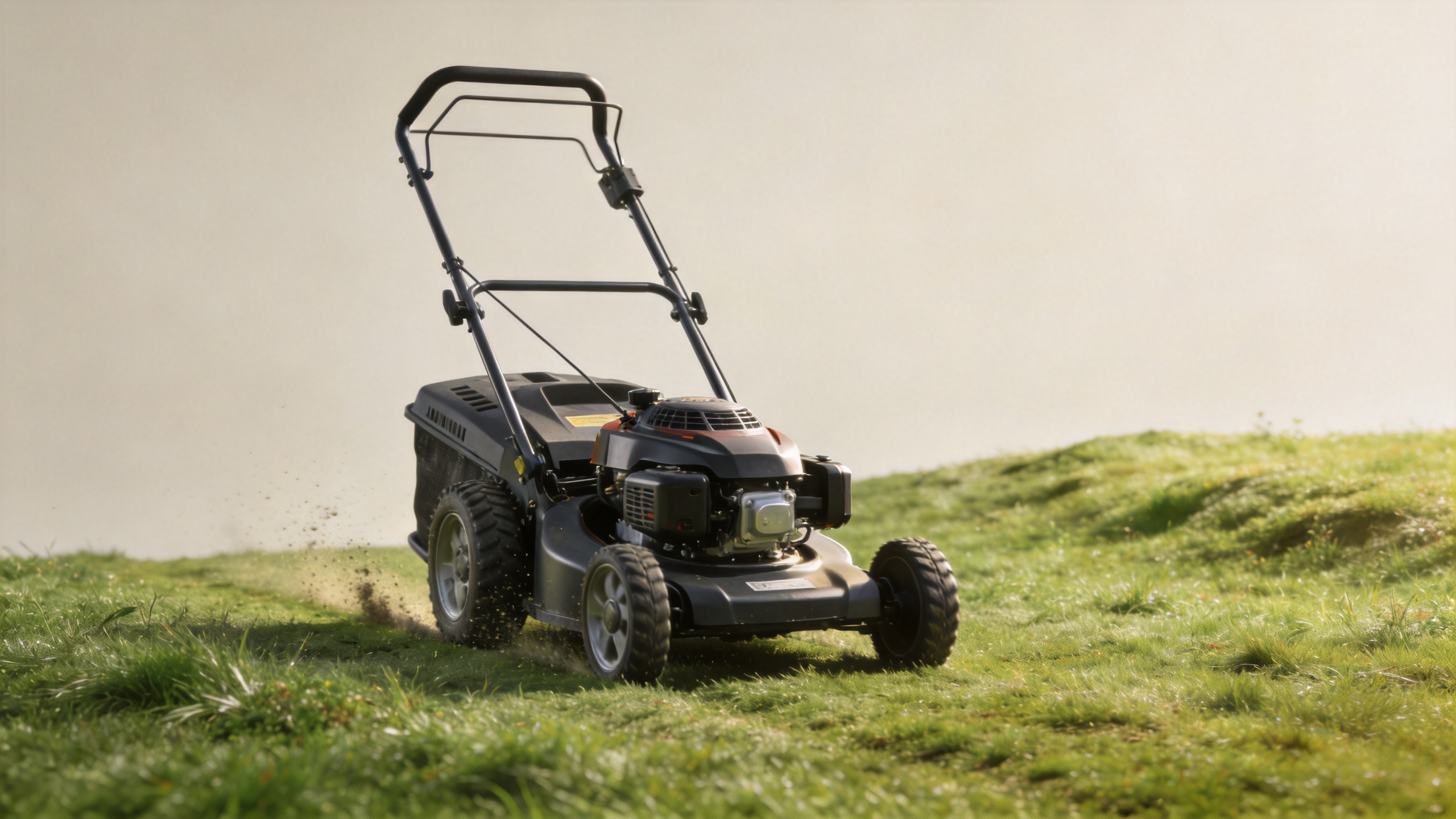
The main advantage of a four-wheel-drive gasoline lawn mower is terrain ability. Large residential lawns, orchard edges, rural properties, and light commercial sites rarely have a perfectly flat, dry surface. A mower that keeps traction through minor changes in surface condition can reduce interruptions and help an operator follow a consistent route.
- Wet or soft grass: power at all four wheels can reduce the tendency of one driven axle to spin.
- Uneven lawns: when one wheel unloads briefly over a bump, the remaining driven wheels can continue helping the mower forward.
- Dense grass: steady travel gives the operator more time to choose a suitable pace rather than forcing the machine through a difficult patch.
- Mixed surfaces: transitions near paths, tree roots, or compacted edges are easier to negotiate with more consistent wheel drive.
For buyers comparing outdoor equipment, this matters because a gasoline lawn mower is often selected for places where cords, charging intervals, and flat-surface assumptions are impractical. Four-wheel drive adds a practical margin of traction, not a substitute for matching cutting width, engine output, deck design, and tire pattern to the site.
More useful mower control at walking speed
Four-wheel drive can also improve mower control. A self-propelled gasoline lawn mower works most comfortably when its travel speed matches the operator’s pace and the turf conditions. If only one axle is driving, a sudden loss of grip may pull the machine off line or make the user compensate with the handle. With traction shared across four wheels, the mower can feel more settled when crossing uneven ground or changing direction around borders.
That steadiness is valuable around trees, beds, and narrow sections where an operator needs to guide a gasoline lawn mower accurately. It may also reduce fatigue over a long session because less corrective pushing is needed. Still, buyers should check whether the drive speed is adjustable, whether the handle controls are comfortable with gloves, and whether the drive disengages cleanly when manoeuvring. Those details determine how much real-world control the system delivers.
Why it can improve productivity for professional users
For a crew responsible for multiple properties, lost traction adds up. Each wheel-spin event can mean a restart, a change of route, or manual pushing through the same area. A four-wheel-drive gasoline lawn mower can reduce those small delays on suitable terrain, helping operators keep a reliable working rhythm. It can be a sensible option for routes with rolling lawns, variable soil, or turf that may be cut in less-than-ideal dry conditions.
That does not mean four-wheel drive is required for every application. On a small, flat, well-drained lawn, a standard self-propelled gasoline lawn mower may provide sufficient performance at lower purchase and service complexity. The stronger case for all-wheel drive appears when the terrain repeatedly exposes the limits of two-wheel propulsion.
Important safety limits: traction is not slope permission
Improved traction should not be interpreted as permission to mow beyond the machine’s stated operating limits. OSHA advises operators to follow the manufacturer’s slope guidance and, when no limit is available for a riding mower, to avoid slopes above 15 degrees. The exact instruction for a walk-behind gasoline lawn mower depends on the specific model, surface, weather, obstacles, and operator procedure.
Before using a four-wheel-drive gasoline lawn mower on an incline, inspect for wet leaves, loose soil, holes, drop-offs, drainage channels, and hidden debris. Use the manufacturer’s direction for mowing across or up and down a slope, keep a conservative pace, and stop if the machine no longer feels stable. Wheel drive improves traction; it cannot remove the risk created by excessive slope, poor footing, or unsafe turns.
What to check before specifying a four-wheel-drive mower
When choosing a gasoline lawn mower, treat four-wheel drive as one item in a wider specification review:
- Terrain profile: map grades, wet areas, rough sections, and obstacle density rather than buying on a drive label alone.
- Drive controls: look for smooth engagement and a speed range that supports precise mower control.
- Deck and cutting height: confirm the deck can suit the turf type and that height adjustment is practical for changing conditions.
- Tires and service access: traction also depends on tire tread, tire condition, and routine maintenance.
- Operator guidance: require clear manuals, safety labels, and model-specific slope instructions for every piece of outdoor equipment.
Is four-wheel drive worth it?
A four-wheel-drive gasoline lawn mower is worth considering when terrain ability, steady propulsion, and lower operator effort are recurring needs. It offers tangible advantages on uneven, damp, or mixed ground and can help users maintain a cleaner mowing line with less correction. For flat lawns, its added cost may bring little day-to-day benefit. The right decision comes from matching the drive system to the property, then confirming the machine’s controls, safety limits, and maintenance requirements before purchase.
For distributors and commercial buyers, the most useful product conversation is not simply “Is it 4WD?” but “On which properties will this gasoline lawn mower give the operator meaningful traction and control?” That question leads to a more accurate specification and a more dependable result in the field.
 Hot News