EN
Lithium Ion Lawn Mower Technology Trends in Future Garden Machinery.
A lithium ion lawn mower is no longer just a motor connected to a removable battery. Buyers now need to consider the pack, charger, cutting deck, electronics and service network as one system. For distributors planning a garden equipment range, the question is not simply which machine has the largest number on its label. It is whether the machine can finish the intended job, recharge in time and remain useful across several seasons.
Several directions are worth watching: battery innovation, better ways to manage power, shared battery platforms and more useful information for operators. Some features are already available on particular models; others are possibilities rather than promises. Treat a technology trend as a question to investigate, not a verified product capability.
Battery innovation: compare usable work, not just voltage
Battery packs combine cells, protective electronics and a housing. Improvements in cell design and pack management may allow future machines to balance energy, weight and heat more effectively. However, a larger pack can also make a mower heavier and more expensive. A lithium ion lawn mower intended for a compact courtyard may benefit more from easy handling than from the largest available battery.
To compare nominal stored energy, multiply nominal volts by amp-hours to get an approximate watt-hour figure. For example, a 40 V, 5 Ah pack represents roughly 200 Wh of nominal energy. That calculation helps describe the pack, but it does not tell you how long the mower will run. Blade load, cutting height, ground conditions, self-propelled drive and battery condition all affect consumption.
Ask suppliers how runtime was measured and whether the stated area assumes light or demanding cutting. A more useful trial is a normal mowing route that includes turns, slopes within the machine's approved limits and the usual collection or mulching setting. For more detail on these distinctions, see our explanation of battery voltage and mower performance.
Motor control and the cutting system work together
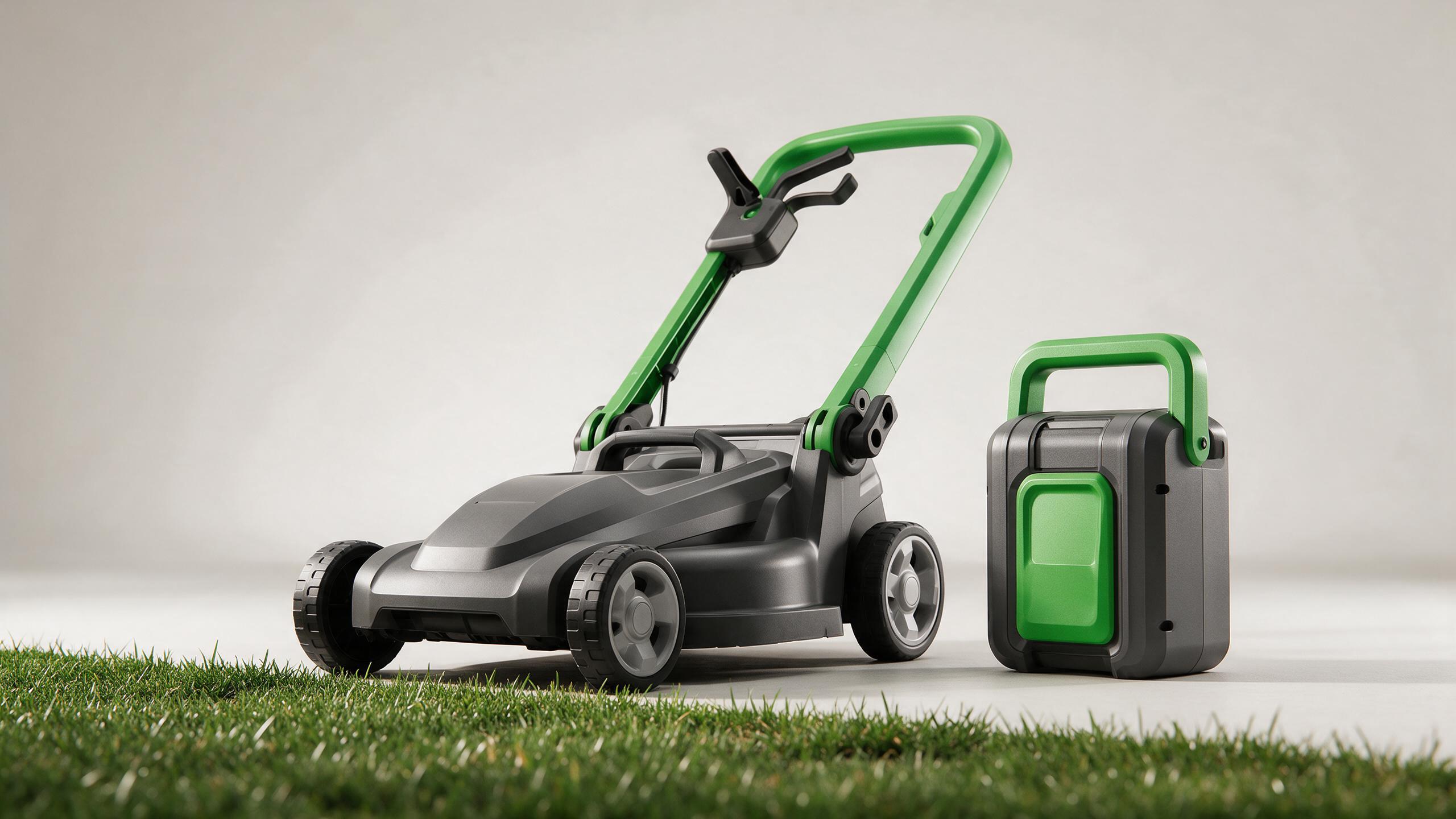
Electric technology can adjust how energy reaches the motor, but a motor specification alone does not predict the finish. Some machines use brushless motors and electronic controls; designs differ in how they respond when cutting resistance rises. A control system may change motor output under load, while the deck and blade still determine how effectively clippings move through the machine.
For a lithium ion lawn mower, compare the whole cutting system: deck width, height adjustment, collection, mulching and access for cleaning. Wider is not automatically more productive. In a garden with narrow entrances and many beds, a smaller deck can be easier to maneuver even if it takes more passes. Test the machine in the configuration in which it will actually be sold, and check the manufacturer's instructions before clearing a blockage or working near the blade.
Manufacturers may continue to refine load sensing and efficiency, but buyers should request evidence for each model rather than assuming that all electronic controls behave alike. Noise also varies with motor, blade, deck and load; compare measured values under the same test conditions instead of treating the power source as the whole story.
Shared battery platforms and charging logistics
One of the most practical future trends is the move toward packs that can be used across more than one tool within a manufacturer's stated platform. A compatible pack can simplify a collection of equipment, but appearance and voltage alone do not establish compatibility. The battery, charger and each tool must be explicitly approved for use together.
For a household, the key question may be whether the same spare pack can power a trimmer after mowing. For a distributor or grounds team, it is also a scheduling problem: how many packs and chargers are needed when several machines are used in succession? A lithium ion lawn mower that completes one site comfortably may still hold up the next job if the charging window is too short.
Before committing to a platform, request a current compatibility matrix, replacement pack availability, charger requirements and warranty terms. Check whether future batteries are planned to work with existing equipment, but treat any roadmap as a plan rather than a guarantee. Electrical supply and charger specifications should be checked for the destination market.
Smart equipment should solve a real operating problem
Smart equipment can mean a charge indicator, a fault message, an app or a fleet dashboard. These functions are not interchangeable, and a lithium ion lawn mower does not need a network connection to be useful. A clear on-machine charge indication may answer a homeowner's main question: can I finish the remaining section before stopping?
For a service team, diagnostic information could help identify a battery or charger issue before a machine is sent for repair. The value depends on what the system actually reports, who can access it and whether the machine remains operable without the app or a subscription. Ask how long software support is expected, what information is collected and what happens if connectivity is unavailable. A simple, repairable machine may be the more sensible choice when those answers are unclear.
Service life, storage and end-of-life handling
Battery innovation is only useful if the pack can be supported after purchase. Ask about replacement pack pricing, parts access, service procedures and whether batteries can be removed without specialist disassembly. Packs naturally change with use and age; actual life depends on the pack design and how it is charged, stored and operated. Avoid promising a fixed number of seasons without model-specific evidence.
Follow the manufacturer’s storage and charging instructions, use only approved chargers, and stop using a damaged pack. The US Environmental Protection Agency advises storing lithium-ion batteries at room temperature and avoiding prolonged exposure to extreme heat or cold. For damaged or swollen batteries, contact the manufacturer or a qualified local handler for instructions rather than attempting a repair yourself.
At the end of a pack's life, local rules and collection options matter. The US EPA advises taking household lithium-ion batteries to a separate battery or household hazardous-waste collection point, not placing them in household trash or ordinary municipal recycling bins. Businesses should check the requirements that apply to their location and waste stream.
A practical checklist for the next purchasing cycle
When reviewing a lithium ion lawn mower for a shop, fleet or garden, start with the actual workload and work backward to the specifications. Ask for:
- Nominal pack voltage and capacity, plus runtime test conditions and a suitable charging plan.
- Approved battery and charger compatibility across the intended tool range.
- Cutting width, height settings and performance in the conditions users are likely to encounter.
- Availability of replacement packs, blades and service support in the destination market.
- Clear safety instructions and applicable product and battery documentation for that market.
- For connected models, the functions available offline and the expected period of software support.
Battery systems may become more capable, but no single feature settles the purchase. Choose a lithium ion lawn mower by matching verified specifications and support to the job; revisit the comparison when a new model has actual test results and documentation. For garden machinery suppliers and distributors, that disciplined approach turns future trends into decisions that can be checked.
 Hot News