
 EN
Future Development Trends of Cordless Lawn Mower Technology.
A cordless lawn mower is moving from a convenient alternative to a more capable part of modern garden equipment. As a garden machinery technical consultant, I look first at the lawn, work pattern, and service plan rather than a headline specification. That matters because the future of a cordless lawn mower will be shaped by battery systems, electronic control, and practical maintenance—not by automation alone.
For homeowners, dealers, and professional users, the useful question is not whether electric technology will replace every other option. It is which advances make a cordless lawn mower more suitable for a particular workload. A small, level lawn and a damp, irregular site can ask very different things of the same machine.
Battery innovation will shift the conversation from runtime to usable energy
Early comparisons of a cordless lawn mower often centered on nominal voltage or a single claimed runtime. Those figures still help, but future battery innovation is likely to make the whole energy system more important: cell management, thermal behavior, charger communication, and how a battery performs as mowing conditions change.
On a dry, regularly maintained turf, a cordless lawn mower may draw power quite differently than it does in tall, wet growth. That is why electronic load sensing and clearer state-of-charge information can be more useful than a simple battery bar. A cordless lawn mower that moderates output under changing resistance may give the operator a more predictable finish, although it cannot remove the underlying limits of battery capacity, deck width, terrain, or cutting height.
Battery innovation should also mean better ownership decisions. Buyers will increasingly look for compatible batteries across garden equipment, transparent replacement options, sensible winter storage guidance, and repair pathways. I used to treat a bigger battery as the entire answer. In practice, charging time, spare-battery logistics, and storage habits can matter just as much for a cordless lawn mower used through a long season.
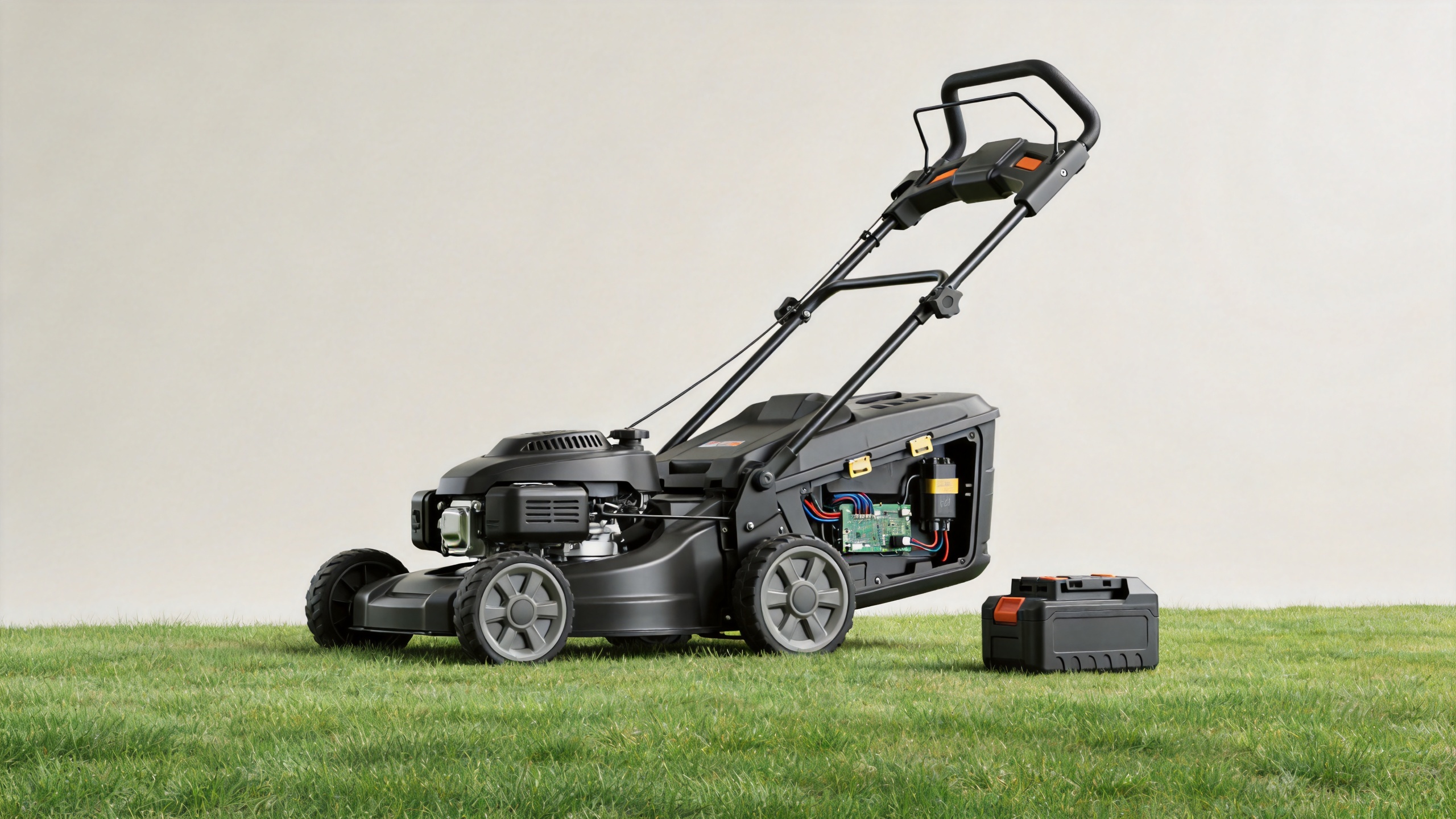
Electric technology will become more responsive, not simply more powerful
Electric technology gives a cordless lawn mower the ability to monitor motor load and adjust behavior quickly. The next useful step is not maximum output in every situation; it is controlled output that matches the cutting load, blade condition, and operator’s chosen cut. This can support smoother work and may reduce unnecessary energy draw during light mowing.
That said, electric technology does not change the basics. A dull blade tears the lawn surface, a clogged deck restricts airflow, and steep or uneven terrain still requires the right traction and handling. A cordless lawn mower should be evaluated as a system: battery, motor control, deck design, wheels, collection method, and service access. For a larger site, the ability to swap batteries or schedule charging may be more valuable than adding software features.
What a smart mower may actually do for the user
The phrase smart mower can cover several different developments. On walk-behind machines, it may mean adaptive power control, maintenance alerts, or a connected battery platform. On autonomous models, a smart mower can also use sensors and, depending on the model, positioning or mapping technologies to navigate a defined area and respond to obstacles.
A future cordless lawn mower may use these inputs to make mowing patterns more consistent, report faults earlier, or help the user plan a charging window. The value depends on the garden. A simple open lawn may benefit from straightforward scheduling, while a complex layout with paths, borders, pets, and seasonal obstacles needs careful setup and supervision. Smart functions are aids to operation, not a reason to ignore safe use or routine inspection.
For dealers, the smart mower opportunity is also a support opportunity. Clear onboarding, firmware-update guidance where applicable, and a realistic explanation of sensor limits can reduce avoidable disappointment. The more connected a cordless lawn mower becomes, the more important product documentation and after-sales knowledge become.
Modular platforms will matter across garden equipment
One likely direction is a shared battery platform across garden equipment. A household that uses a mower, trimmer, blower, or other tools may value fewer chargers and a more manageable battery inventory. For a cordless lawn mower, platform compatibility can make seasonal planning easier, especially when an additional battery is available for periods of heavier growth.
Compatibility should still be checked carefully. Similar-looking packs are not proof of electrical or mechanical compatibility, and capacity alone does not confirm that a battery fits a given task. Buyers should compare the approved battery range, charging arrangement, service availability, and expected workload before building a garden equipment platform around one purchase.
Traceability and serviceability will become stronger buying criteria
Battery regulation and lifecycle reporting are developing alongside battery innovation. In the European context, Regulation (EU) 2023/1542 is pushing attention toward battery information, traceability, and lifecycle responsibilities for covered battery categories. It would be inaccurate to say that every battery in a cordless lawn mower has identical obligations, but the wider direction is clear: supply-chain documentation and end-of-life handling will matter more.
This trend favors questions that buyers can ask today: Can the battery be identified? Is replacement guidance available? What are the storage instructions? Is there a defined route for recycling? A cordless lawn mower with well-explained service and battery information may be easier to support over time than one assessed only on its initial specification list.
How to interpret the next generation of cordless mowing
When evaluating a future-facing cordless lawn mower, separate useful progress from marketing language. Start with the site: lawn area, vegetation density, slope, access points, and how often the lawn is cut. Then examine the battery platform, charging routine, blade and deck maintenance, and the level of smart mower support that the user can genuinely use.
- Choose battery capacity and spare-battery planning around the real mowing cycle.
- Check whether electric technology adapts to load and gives understandable status information.
- Treat connected functions as practical tools, not as a substitute for safe operation.
- Ask about battery storage, replacement, recycling, and service support before purchase.
The direction of travel is practical: a cordless lawn mower will become more connected, more energy-aware, and more integrated with garden equipment. Yet the right model will still depend on terrain, workload, and the owner’s willingness to maintain the battery and cutting system. That is a more useful standard than assuming every new feature suits every garden.

 Hot News