EN
How Long Can a Lithium Ion Lawn Mower Operate on One Charge?
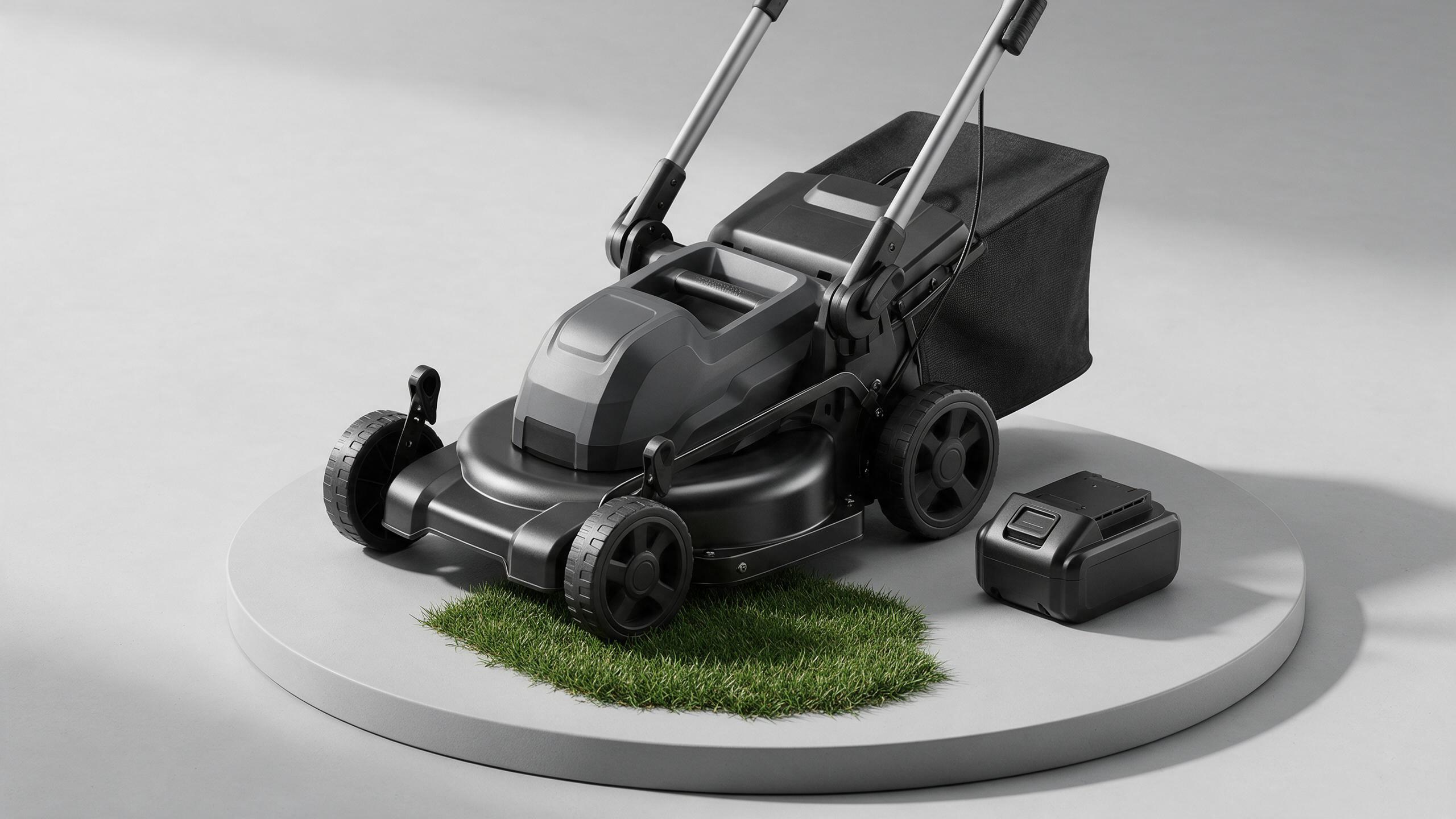
A lithium ion lawn mower may run for roughly 30 to 60 minutes on one charge, but that is an orientation, not a promise for every machine. Actual battery runtime depends on the mower, battery, turf and operator. A light weekly cut on a flat lawn can take less energy than a first cut through tall, damp growth. Check the stated test conditions for the particular model before relying on a published number.
What matters is whether a charge will cover your mowing route. A run of 40 minutes means little if the job takes 50, and a larger battery is not the only way to close that gap. Cutting height, drive use and the time needed to turn around obstacles all change the result.
What determines battery runtime?
Battery capacity and energy
Battery capacity is often given in amp-hours (Ah), while voltage (V) describes the electrical system. Watt-hours (Wh) combine the two: nominal voltage multiplied by amp-hours gives an approximate energy rating. For example, a hypothetical 40 V, 5 Ah pack stores about 200 Wh by that calculation. This is arithmetic, not a specification for a particular lithium ion lawn mower.
A second hypothetical pack rated at 40 V and 7.5 Ah works out to about 300 Wh. At the same average load, the larger pack contains approximately half as much energy again. On a real lawn: usable energy, battery age and machine controls differ, and advertised maximum voltage should not be mixed with nominal voltage when making comparisons. Use the Wh printed on the pack where available and compare compatible packs for the same system.
Cutting load and working conditions
Dense, long or damp turf usually asks more of the cutting system than a dry, regularly maintained lawn. On demanding patches, a lithium ion lawn mower may raise motor output or slow down, drawing energy more quickly. A shallow cut taken regularly can reduce load; follow the machine manual and avoid operating in conditions the maker advises against.
Hills, soft ground and a self-propelled drive also affect energy use. A drive function can make a slope easier to manage, but the drive draws from the same battery. If your plot has narrow passages or many trees, turning and overlapping passes may increase the time needed to cover it. A wide deck is useful on open areas, yet it may be awkward around closely spaced beds.
Estimate whether one charge will finish the job
Start with a measured mowing time rather than the total property area. Exclude the house, paths and planted areas, then note how long the actual lawn takes under ordinary conditions. If a lithium ion lawn mower has a stated runtime, ask how the figure was measured: was the blade cutting, was the drive engaged, and what battery was fitted? A no-load figure is not equivalent to a cut through dense growth.
For an illustrative energy estimate, divide available watt-hours by average power in W and multiply by 60 to get minutes. At an assumed average draw of 400 W, a nominal 200 Wh pack gives 30 minutes on paper. This ignores losses and reserve capacity; power draw also changes while cutting. It is a planning example, not a prediction or a test result. Without a credible average power figure, the calculation cannot give a reliable runtime.
Now compare that estimate with the whole job. If a route takes about 35 minutes and the machine's representative tested runtime is 30 minutes, allow for a pause or choose a compatible battery arrangement with more capacity. If the route takes 20 minutes, the same specification leaves a margin on that particular test. Keep additional margin for heavier seasonal growth and battery ageing rather than sizing to the exact minute.
How to improve mower efficiency without compromising safety
- Adjust the cut. Raise the deck for overgrown areas and, when appropriate, take another pass later rather than forcing a deep cut in one go.
- Maintain the blade and deck. Follow the manual for inspection and cleaning. Switch off the machine and remove the battery and any safety key before touching the blade or clearing packed clippings.
- Plan the route. Make steady passes with only the overlap needed for an even cut. Avoid repeatedly covering ground that has already been cut.
- Use drive assistance deliberately. Where the machine permits, use the drive when it is helpful and follow the manufacturer's instructions for slopes and traction.
- Measure on your own lawn. Record the cutting time and battery level after a normal session, then compare again when growth is heavier. These observations are more useful than a single advertised maximum.
These steps can help mower efficiency, but some lawns still need more than one charge. If the battery repeatedly runs short, the practical answer may be another compatible pack, a larger approved pack or a pause between sections. Check the manual before assuming that a pack from another tool or platform will fit.
Charging time matters as much as cutting time
Charging time depends on the battery and the charger supplied or approved for it. A larger pack can extend cutting time, yet it may also require a longer recharge with the same charger. Ask for the charging time of the exact battery-and-charger combination, not a figure for a different pack. Charging is not simply capacity divided by charger output: charging rates can change as the battery fills.
For a larger property, compare two schedules: mow part of the lawn and wait for the pack to recharge, or rotate compatible batteries while observing the maker's charging instructions. Count the charging wait in the total job time. A spare pack only reduces downtime if it is charged and available when needed; it does not change the runtime of the first charge.
Care for the battery between mowing sessions
Follow the battery and charger instructions for the permitted temperature range, storage charge and any cooling period after use. Charge in a suitable dry location where the battery can be observed, using the manufacturer-specified charger. Do not charge a visibly damaged pack, and keep it clear of heat and combustible materials. If the pack is hot, allow it to cool as directed before charging.
For more on storage and routine care, read our cordless mower battery care guide. A pack that has aged or been stored outside its recommended conditions may deliver less useful work than when new; consult the maker if performance drops sharply or damage is visible.
Questions to ask before choosing a lithium ion lawn mower
Which pack and charger are included? Is the quoted battery runtime measured with the blade cutting and the drive engaged? Can an approved higher-capacity pack or spare be used? What is the charging time for that exact combination? Ask for model-specific documentation, then measure your route on a typical day. A lithium ion lawn mower is a practical fit when its tested cutting time, reserve and charging plan match the work you actually need to finish.
 Hot News