EN
What Features Should Professional Ride On Mowers Include?
A professional ride on mower should match the work a crew actually does: cutting cleanly, fitting the site, keeping operators in control and remaining practical to service. A large deck or a powerful engine alone cannot answer all of those needs. Start with a typical working week, not a single catalogue number.
For a contractor or distributor, the useful question is how a ride on mower behaves across open areas, narrow access points, damp turf and repeated transport. Use the following features as a practical specification checklist. Availability and suitability vary by model, so ask the supplier for the exact documentation before ordering.
Match the cutting system to the sites
Deck width affects how much ground a ride on mower can cover in a pass, but a wider deck need not be faster. Measure the narrowest gate, trailer ramp and regular passage between obstacles. A commercial mower that cannot reach those areas leaves extra trimming for the crew. On an open playing field, a wider deck may reduce passes; on a landscaped estate with trees and paths, a narrower deck may save time in turns and follow-up work.
Inspect the cutting system as a whole: deck construction, height adjustment, blade access and the method used to move clippings. Ask how easily the height setting can be checked and changed between sites. Deck wheels or other anti-scalping provisions may help on uneven ground, but they do not make a ride on mower suitable for every surface.
Choose collection, side discharge or mulching according to the contract rather than assuming one mode fits all work. Collection can leave a tidy finish but adds emptying stops. Mulching returns small clippings to the turf and works more consistently when growth is not excessive. University of California guidance recommends removing no more than one-third of the blade height at a time; an adjustable deck and a suitable cutting schedule make that practice easier.
Look beyond engine power and top speed
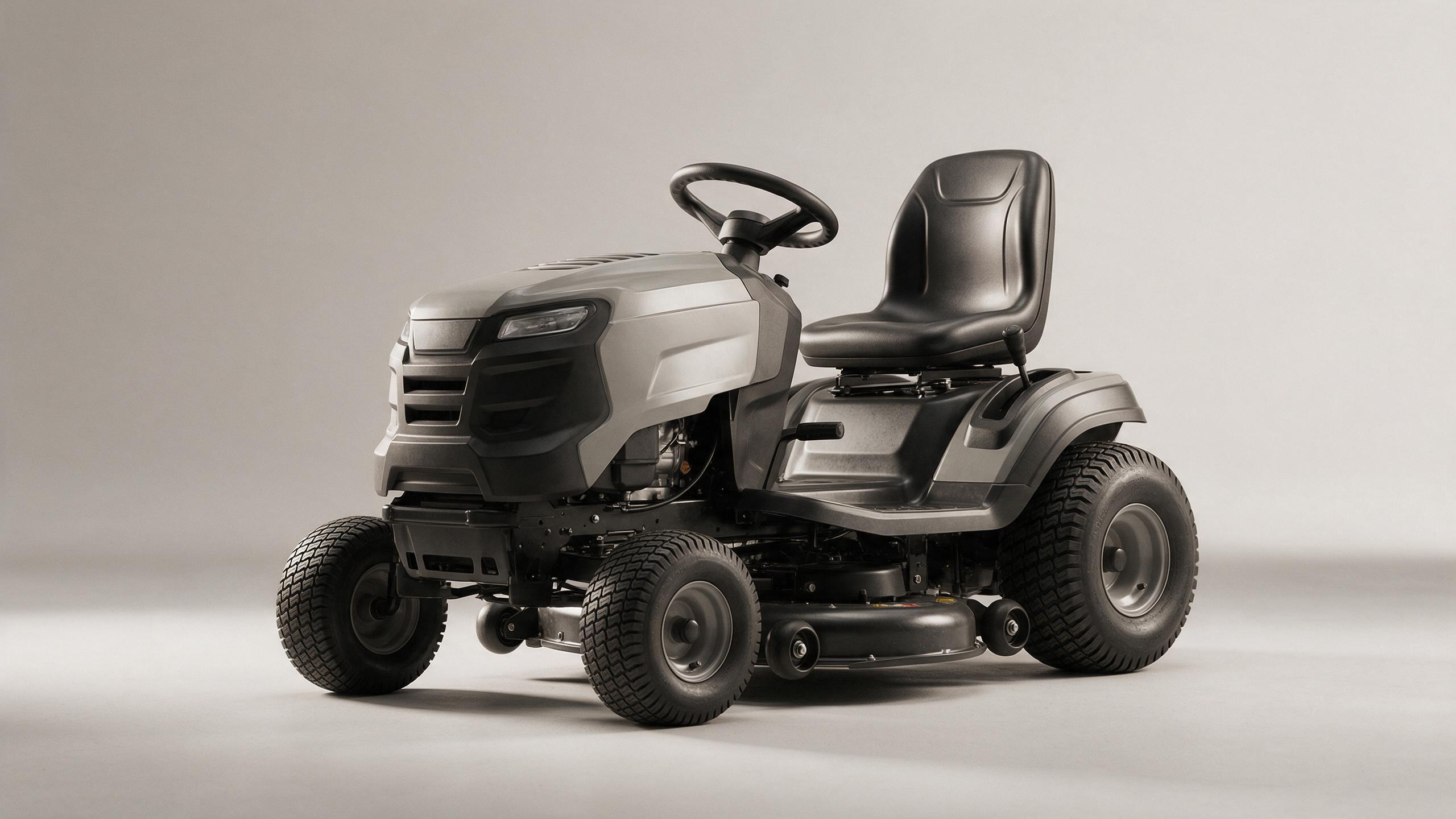
A ride on mower needs enough usable power for its deck, terrain and expected growth. Ask for the rated engine or motor output, the recommended duty and the service schedule for the exact model. A specification sheet narrows the field. A demonstration in representative conditions shows whether the ride on mower maintains a consistent cut without requiring the operator to rush.
Drive controls matter just as much in a crowded landscape. Smooth speed changes and predictable steering help an operator work around trees, borders and parked vehicles. Hydrostatic drive, where fitted, allows variable speed control; compare the controls and maintenance requirements rather than assuming every system operates alike.
For productivity, time the full job, including turning, clipping disposal, loading and touch-up work. A ride on mower with a high stated travel speed may not complete the route sooner if it is awkward at entrances or requires frequent unloading. Compare machines on the same site and under similar conditions.
Prioritise safety and terrain suitability
A professional ride on mower should have functioning guards, a discharge shield, operator-presence controls and starting interlocks as specified by its manufacturer. Inspect these before use and do not bypass them. Operators need training on the controls, pedestrian separation, debris checks and shutdown procedure. Stop the machine and wait for moving parts to stop before clearing a blockage or carrying out service, following the model manual.
Slopes demand a site assessment, not a sales claim. Check the ride on mower manufacturer's slope limits and operating instructions, then assess traction, moisture, drop-offs and obstacles. OSHA advises avoiding slopes above 15 degrees when the manufacturer's slope limit is unavailable; that is not a universal safe limit, and a lower model limit still applies. If the terrain or conditions are unsuitable, use another appropriate method rather than forcing the machine onto the slope.
Ask whether rollover protection is supplied or required for the ride on mower and how it must be used. Where a manufacturer-specified rollover protective structure is fitted, follow the instructions for its position and seat belt. Do not assume a structure permits operation beyond the machine's rated conditions.
Make operator comfort part of the specification
A crew may spend hours on a ride on mower, making fit and visibility practical purchasing criteria. Check whether the seat can be adjusted for the people who will use it, whether controls are reachable without stretching and whether the operator can see the deck edges and surrounding area. Try the machine while stationary and during an authorised demonstration.
Operator comfort also depends on the surface and the task. Seat support and vibration isolation, if offered, should be evaluated on the actual terrain; neither replaces suitable breaks, training or a machine appropriate to the site. On shared equipment, quick and clear adjustments can help different operators establish a controlled working position.
Check service access and ownership costs
A ride on mower that is easy to inspect may spend less time waiting for routine work. Ask a service technician to show access to blades, belts, filters and lubrication points where applicable. Confirm the prescribed maintenance intervals, the tools required and how wear parts are identified. Before any inspection, follow the manual's shutdown and energy-isolation instructions.
Request a parts list, local service contact and written warranty terms for the intended commercial use. A lower initial price for a ride on mower can be offset by frequent consumable replacement or long repair waits. Include expected servicing, transport, energy or fuel, and downtime in the comparison. For fleet purchases, check parts commonality across models rather than presuming components interchange.
A practical buying checklist
Before selecting a ride on mower, document the work and ask the supplier to confirm each point for the proposed model:
- Site fit: deck width, access clearances, turning space and transport dimensions.
- Cut quality: height range, adjustment method and suitable clipping-handling options.
- Safety: applicable slope limit, guards, interlocks and rollover protection instructions.
- Daily use: control layout, visibility, seat adjustment and operator training.
- Support: service intervals, parts availability, warranty coverage and local repair arrangements.
A suitable ride on mower is the one whose documented capabilities match the actual contract and whose upkeep the crew can support. Ask for a representative demonstration and a written specification before committing to a fleet or a distribution order.
 Hot News