EN
What Should Importers Consider When Buying Ride On Mowers?
Buying a ride on mower for distribution is a different decision from choosing one for a single property. An importer has to protect a seasonal inventory plan, a retail reputation, and an after-sales commitment at the same time. The quoted unit price matters, of course, but it is only one line in the total cost of bringing a machine to market.
For a procurement team, the useful starting point is a written acceptance standard: which terrain and end users the ride on mower is meant for, which documents must accompany it, what a production sample must demonstrate, and what happens when a field issue appears after arrival. That framework turns supplier evaluation from a catalogue comparison into a controlled buying decision.
Start with the market, not the supplier catalogue
Before requesting quotations, define the buyer profile for each proposed ride on mower. Is the range intended for large, open lawns; mixed residential layouts; commercial grounds; or dealers serving owners with slopes and uneven surfaces? Those use cases change the importance of cutting-deck width, turning layout, traction, collection options, operator comfort, and service access.
Do not assume that a wider deck is automatically the stronger commercial offer. On a complex property, clearance around trees, narrow access points, and landscaping can matter more than nominal coverage per pass. Likewise, a higher engine figure alone does not establish suitability for slopes or heavy seasonal use. Ask the supplier to map every proposed configuration to a stated operating condition and to identify its limits.
An importer guide should also define the sales-season calendar before the factory discussion begins. Garden-machinery demand is concentrated around spring and early summer in many temperate markets. A late container, incomplete parts kit, or delayed manual can leave a dealer with stock that misses its main selling window.
Evaluate the supplier as a long-term operating partner
A disciplined supplier evaluation reviews more than a factory tour and a price sheet. Importers should ask who owns engineering changes, how components are approved, how serial or batch traceability works, and which team will respond to warranty cases. A supplier that can explain these controls clearly is easier to manage when a production issue needs containment.
- Manufacturing control: Request the process flow, incoming-inspection approach, critical assembly checks, and treatment of nonconforming units.
- Engineering ownership: Confirm who approves drawings, bill-of-material changes, labels, manuals, and replacement parts lists.
- Capacity and timing: Review realistic production lead times, peak-season capacity, packaging lead time, and port-ready milestones.
- Service readiness: Ask for recommended spare-parts packages, parts identification, warranty workflow, and escalation contacts.
- Communication discipline: Agree on document versions, sampling approval, inspection notices, and how deviations are reported before shipment.
For an OEM mower programme, separate cosmetic customisation from changes that affect safety, assembly, parts compatibility, or documentation. A logo, colour, or carton artwork can look simple; a new control layout, deck option, or engine package may require a fresh engineering and conformity review. Put that boundary in the development plan rather than discovering it during production.
Turn the sample into a measurable approval gate
Do not approve a ride on mower solely from images, a brochure, or a short demonstration. The pre-production sample should be checked against an agreed specification pack with drawings, component list, label artwork, packaging requirements, and a test plan. The same pack should follow the order through mass production.
Useful sample checks include cold and warm starting, steering and drive engagement, cutting-height adjustment, blade and safety-control response, vibration, brake function, deck discharge or collection behaviour, tyre condition, fastener condition, and access for routine maintenance. Where a claim depends on a test report or a rated specification, ask for the underlying document instead of treating a sales statement as proof.
It is also worth checking the practical details that become dealer complaints: whether instructions match the delivered controls, whether the parts list uses stable references, whether fluids and fasteners can be accessed safely, and whether the crate or carton protects the machine through normal handling. These are modest checks individually, but together they shape the ownership experience.
Plan quality inspection before the purchase order is released
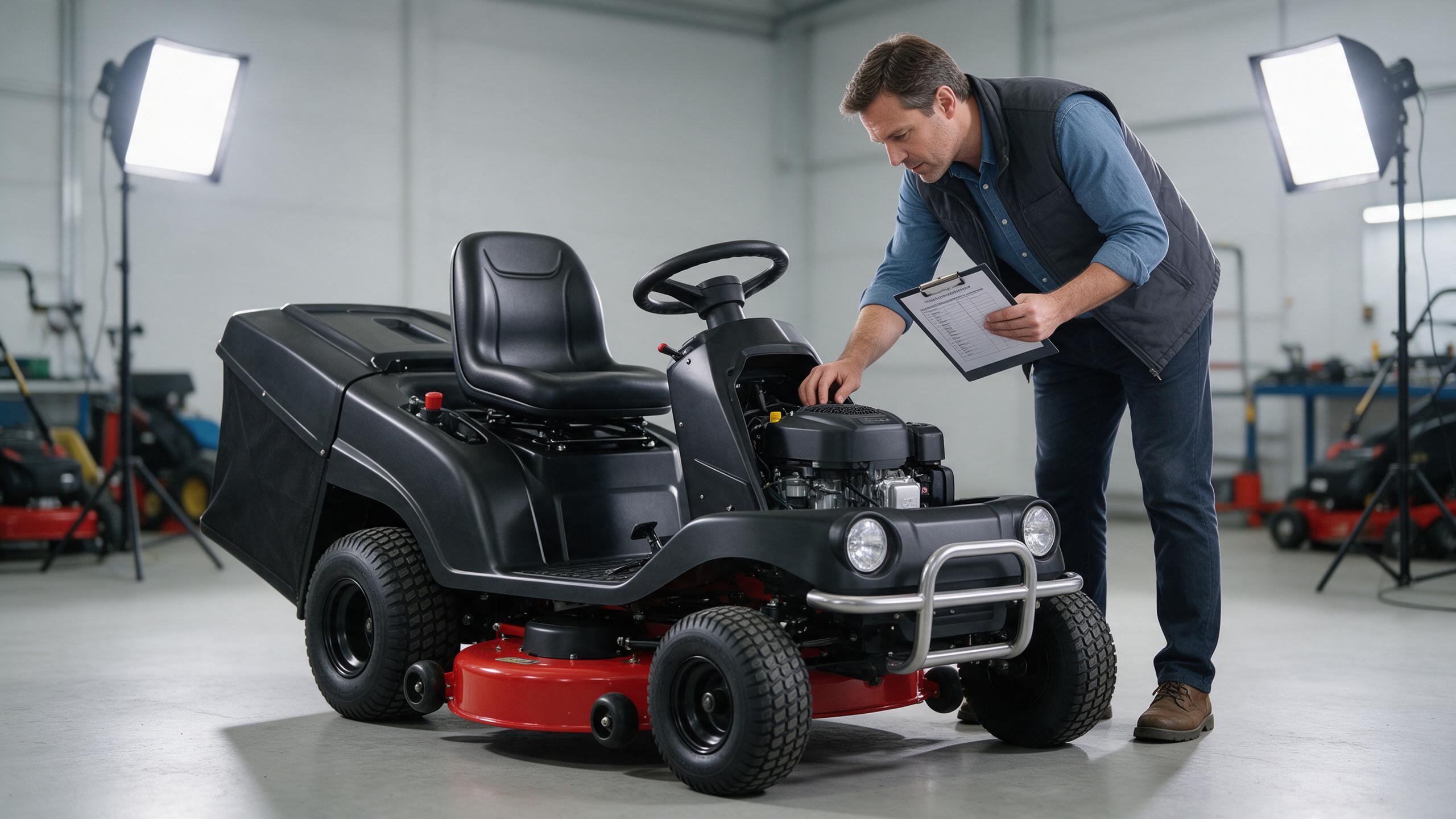
Quality inspection works when it is an agreed system rather than a last-minute visit. Define the inspection stages in the purchase order: pre-production approval, in-process checks where relevant, final random inspection, and loading confirmation. State the sampling method, critical defects, major defects, functional tests, photo requirements, and the decision rule for release or rework.
For a ride on mower, the final inspection should include identity and configuration checks as well as function. Verify model, engine or drive configuration, labels, manuals, accessories, guards, tyres, paint or finish, fasteners, safety controls, packaging marks, and the approved spare-parts pack. Test a representative sample under conditions that reflect the agreed specification; do not turn a vague “works normally” note into a shipment release.
Keep inspection findings traceable by order, batch, and corrective action. If a defect recurs, the supplier and importer need to know whether it is tied to a component lot, an assembly station, a design change, or handling after production. That evidence is far more useful than an argument over isolated photos.
Check compliance documentation early and keep it version-controlled
Importers selling into regulated markets should obtain market-specific advice and ask the supplier for the relevant evidence well before shipment. In the EU, machinery placed on the market before 20 January 2027 remains under the current Machinery Directive 2006/42/EC; the newer Machinery Regulation (EU) 2023/1230 applies from that date. The practical lesson is to confirm which framework applies to the shipment date and market, rather than relying on a generic statement in a quotation.
Request a controlled documentation list for the exact ride on mower configuration: declaration material where applicable, manuals in required languages, labels, technical-file support, test evidence, and any noise or emissions information relevant to the target market. An OEM change can invalidate assumptions made for an earlier model, so keep approved documents tied to a model and revision level.
Compare total landed cost and service exposure
The lowest ex-works quote can become the more expensive option if it produces more rework, missing parts, avoidable claims, or slow technical responses. Compare candidates using a landed-cost view that includes tooling or development charges, freight and packaging, inspection, spare parts, expected warranty handling, and the administrative cost of compliance documentation.
There is a useful shift in thinking here. Many buying teams begin with the unit price, then discover that service parts, documentation gaps, and seasonal delays drive the real outcome. A supplier relationship should therefore be reviewed against reliability of delivery and resolution, not simply the first order.
A practical pre-order checklist
- Define target terrain, user segment, sales season, and required ride on mower configurations.
- Approve a specification pack that controls the sample, production units, labels, manuals, and packaging.
- Complete a documented supplier evaluation covering process control, engineering, capacity, traceability, and after-sales support.
- Validate an OEM mower sample against functional, safety, serviceability, and documentation requirements.
- Agree a staged quality inspection plan with objective release criteria and corrective-action ownership.
- Verify applicable market documentation with qualified regulatory support before committing to shipment.
- Order an appropriate spare-parts package and assign clear warranty contacts before the selling season.
Make the buying decision auditable
A sound ride on mower purchase is one that another member of the team can review and understand months later: the intended market is clear, the approved sample is identifiable, the inspection rules are written down, and the supplier’s obligations are documented. That level of discipline does not remove every uncertainty, but it gives an importer a practical way to manage quality, timing, and service risk before inventory is on the water.
 Hot News