
 EN
Why Do Contractors Still Choose Gasoline Lawn Mowers?
For landscaping contractors, a gasoline lawn mower remains a working tool rather than a nostalgia purchase. Battery equipment has made strong progress, especially for smaller, quieter sites. Yet a crew moving through several properties in one day still judges a machine by whether it keeps the route moving: can it handle dense turf, return to work quickly, and stay serviceable when the schedule is tight? In those conditions, a gasoline lawn mower can remain a practical part of professional equipment planning.
The point is not that one power source suits every crew. A gasoline lawn mower creates noise, requires routine engine care, and may face local operating restrictions. But when contractors compare actual working conditions rather than headline features, the case often comes down to uptime, terrain, workload, and the cost of interruptions.
The contractor calculation is time on site
A landscaping business does not measure productivity only by the minutes spent cutting. It also counts travel between jobs, unloading, refuelling or charging, blade checks, collection-box stops, and unexpected downtime. A gasoline lawn mower can fit a route with mixed property sizes because fuel can be replenished quickly without waiting for a charge cycle. That matters when a crew has a long day of scattered appointments or when turf has grown beyond the condition expected at booking.
For a commercial mower fleet, the useful question is: how much productive cutting can each operator complete between planned stops? A gasoline lawn mower may be appropriate where access to electricity is limited, mowing windows are compressed by weather, or multiple operators share equipment through the day. This does not make cordless equipment unsuitable; it means the energy plan must match the route.
Where a gasoline lawn mower still fits professional work
Large, uneven, or overgrown sites
Long turf, variable terrain, and damp patches place a different load on equipment than a short, dry residential lawn. A gasoline lawn mower is often considered for these jobs because the operator can keep working without carrying a charging setup from site to site. The number worth checking is not engine size alone. It is the combination of usable torque, deck design, traction, cutting width, and the machine’s ability to discharge or collect turf under the conditions the crew actually faces.
That distinction is important. A larger engine does not automatically improve a job outcome if the deck clogs, the drive system struggles on slopes, or the operator spends too much time emptying the collector. Landscaping contractors should assess the full work cycle, including the finish required by the client.
Back-to-back jobs with limited charging access
On a multi-stop route, a gasoline lawn mower offers a simple energy workflow: inspect fuel and oil before departure, carry approved fuel safely, and schedule refuelling clear of ignition sources. For crews that cannot return to a depot between jobs, that workflow can be easier to plan than locating outlets, transporting several battery packs, or assigning charging responsibility across the team.
Productivity, however, should not be confused with running equipment continuously. A well-managed crew builds in cleaning, blade inspection, and safe cooling time. A gasoline lawn mower earns its place when those maintenance tasks are predictable and the machine can be returned to service without disrupting the whole day.
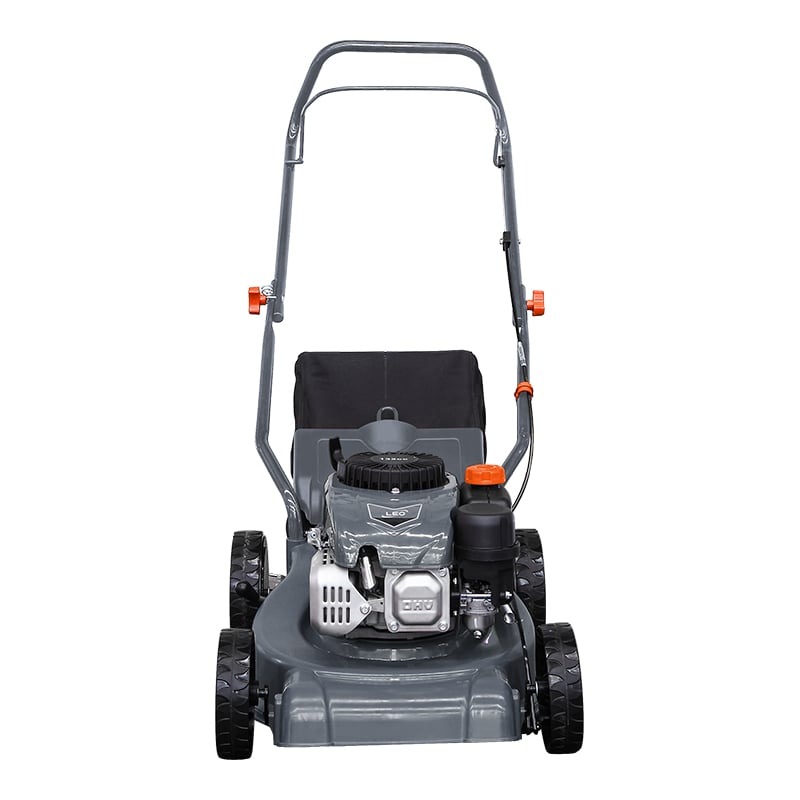
 Routine inspection helps keep a contractor mower available between scheduled jobs.
Why durability and serviceability matter more than a purchase price
Professional equipment is exposed to repeated loading, vibration, debris, and use by more than one operator. For that reason, a commercial mower decision should begin with construction and service access. Contractors commonly look for a deck and handle assembly suitable for frequent work, accessible filters and oil-service points, a practical blade-change process, and parts support that fits their market.
A gasoline lawn mower also has recurring needs: fuel management, engine oil checks, air-filter care, spark-plug inspection, and seasonal storage preparation. Those costs should be included in total cost of ownership rather than treated as an afterthought. In return, an established maintenance routine can make machine availability easier to forecast. The right choice depends on whether the crew can carry out that routine consistently.
Ask a supplier for the maintenance schedule, parts diagrams, service documentation, and expected consumables before adding a gasoline lawn mower to a fleet. A lower initial price has little value if a common wear item holds the machine out of service during the busy season.
Noise, emissions, and the jobs a gasoline lawn mower should not take
There are clear limits to the gasoline case. A gasoline lawn mower may be a poor fit for early-morning residential work, enclosed courtyards, noise-sensitive facilities, or locations with rules that favour low-noise equipment. European buyers should also verify that an engine and the relevant documentation suit the destination market. EU rules governing non-road mobile machinery engines and outdoor-equipment noise information make compliance review a procurement task, not a detail to leave until delivery.
That is why many professional fleets use a mixed approach. Cordless tools may serve short routes, noise-sensitive sites, and finishing work, while a gasoline lawn mower covers heavier cutting or remote properties. The power source is a job-allocation decision, not a statement of brand identity.
A practical selection checklist for landscaping contractors
- Map the route: Record property size, turf condition, slopes, access, and time available at each stop.
- Measure interruptions: Compare refuelling, charging, collection-bag emptying, cleaning, and transport time—not cutting time alone.
- Check the commercial mower build: Review deck construction, drive components, handle joints, wheels, and vibration controls for the expected workload.
- Plan service: Confirm local parts access, routine maintenance points, and who will carry out pre-season and in-season checks.
- Verify compliance: Match noise, emissions, safety, and documentation requirements to every intended market and jobsite.
The bottom line
Contractors still choose a gasoline lawn mower because many routes reward predictable runtime, rapid refuelling, and a familiar service routine. It is not the automatic answer for every property, and it is often the wrong answer where noise and local restrictions dominate. But for demanding schedules, larger areas, and heavier turf, a gasoline lawn mower can remain a sensible productivity tool when it is specified, maintained, and assigned to the right work.


 Hot News