EN
How Lithium Battery Technology Improves Electric Tillers?
An electric tiller is no longer defined only by a cord or a small motor. Lithium battery technology has changed how a cordless machine can be planned, carried, and used around a garden, courtyard, or landscape-maintenance site. For buyers evaluating an electric tiller, the useful question is not simply “How long will the battery last?” It is whether the battery, motor, tines, soil conditions, and work pattern fit together for the jobs at hand.
From a garden-machinery perspective, that system view matters. Loose vegetable-bed soil, soil that has been watered recently, and compacted ground place very different loads on an electric tiller. Lithium battery technology does not remove those differences. It gives designers and users a more flexible energy source to manage them.
Why a lithium battery changes the cordless tiller experience
A lithium battery stores a useful amount of energy in a relatively compact, rechargeable pack. The U.S. Department of Energy identifies high power-to-weight ratio, high energy efficiency, long life, and low self-discharge as general lithium-ion characteristics. In garden tools, those traits can help an electric tiller avoid the extension-cord limits of a corded model while remaining easier to move than a machine built around a combustion engine.
Energy density is an important background concept. It describes how much energy a battery can hold for its size or weight. A more energy-dense pack can give an electric tiller a practical cordless format without making the tool unnecessarily bulky. It does not mean every lithium battery has the same capacity, runtime, or output. Buyers still need to read the actual battery voltage, amp-hour rating, compatible charger information, and tool documentation.
The clearest day-to-day change is mobility. With a cordless tiller, an operator can work beyond the reach of an outlet, move around raised beds, and avoid routing a power lead across paths or planting areas. This can simplify setup for small plots and for intermittent cultivation work. It also makes an electric tiller easier to stage near the work area rather than near a socket.
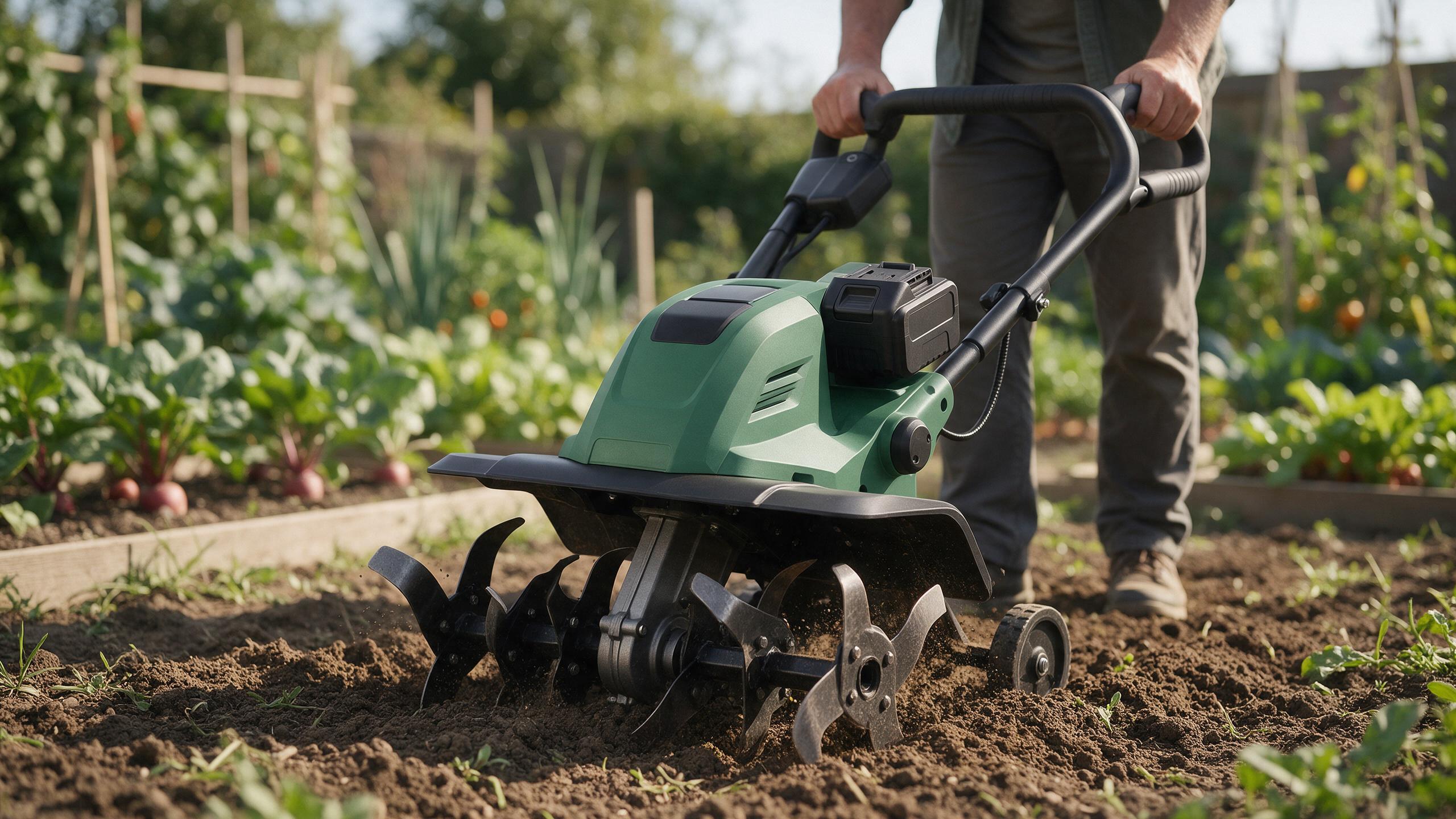
How the battery and motor use energy during tilling
Battery capacity alone does not tell the whole story. An electric tiller draws more power when its tines meet dense, dry, root-filled, or compacted soil. It normally draws less when it is making a shallow pass through prepared soil. Working width, depth setting, tine design, travel speed, and how often the operator stops and restarts all affect energy demand.
That is where energy efficiency shows up in the work itself. A well-matched electric drive can turn battery energy directly into tine rotation without the idling and fuel-handling routine associated with engine-powered electric equipment. However, efficient use still depends on technique. Forcing an electric tiller too deep on the first pass can increase load, reduce the workable session, and leave a rough finish.
A steady approach often makes better use of the charge:
- Start with a shallow pass when soil is firm or previously untilled.
- Clear wire, stones, heavy roots, and debris before using the electric tiller.
- Make additional passes only where the planting plan needs more depth.
- Use a charged spare pack when the work area is larger than one expected session.
- Let the tool cool and follow the manufacturer’s battery-care instructions between demanding jobs.
These habits help users allocate battery energy to soil preparation rather than wasted resistance. They also make runtime planning more realistic than relying on one published figure taken under different soil conditions.
What to compare when choosing an electric tiller
When comparing an electric tiller, treat the battery platform as part of the tool, not an accessory added at checkout. Voltage is commonly associated with the operating platform, while amp-hours indicate stored capacity. Multiplying volts by amp-hours gives a rough watt-hour comparison, but it does not replace a review of motor design, speed control, tines, working width, soil type, and the intended duty cycle.
| Factor | Why it matters for battery-powered tilling | Practical buying question |
|---|---|---|
| Battery platform | Determines compatible packs, chargers, and possible shared-tool use. | Can the lithium battery work across other garden tools you need? |
| Battery capacity | Influences how much stored energy is available for a session. | Is one pack sufficient for your beds, or is a second pack sensible? |
| Tilling width and depth | Wider or deeper work can change the load on an electric tiller. | Does the tool match a narrow bed, an established garden, or broader open ground? |
| Soil condition | Dense or rocky soil can demand more torque and energy. | Will you make staged passes rather than expect one deep pass? |
| Service support | Battery replacement and parts planning affect long-term ownership. | Are packs, chargers, and service information available for your market? |
For distributors and professional buyers, platform compatibility can simplify planning. A shared lithium battery platform may simplify inventory across related electric equipment, although actual compatibility must be confirmed from the supplier’s documentation. For a homeowner, it may reduce the number of charger types kept in the shed.
What cordless operation can and cannot improve
A cordless tiller can make short, repeated cultivation tasks more convenient because there is no cord to position before each job. It can also reduce local operating noise and direct engine exhaust compared with a combustion-engine tiller. These are meaningful working-environment advantages, especially around homes, courtyards, or municipal green spaces where timing and access matter.
Even so, a battery-powered electric tiller is not the right substitute for every soil-preparation task. Very large acreage, heavily compacted ground, or repeated deep cultivation may call for a different machine category or a staged work plan. The right choice comes from matching capacity and tool design to the area, soil, and schedule rather than assuming a larger battery solves every challenge.
Get more useful work from each charge
Plan the site before bringing out the electric tiller. Mark the beds, remove obstructions, and decide which areas need shallow aeration versus deeper mixing. Charge the lithium battery with the specified charger in a suitable environment, inspect the pack and contacts, and store batteries according to the maker’s instructions. Avoid leaving a pack in conditions the manual identifies as unsuitable.
During use, listen for a change in tine speed and watch how the soil breaks apart. If the electric tiller is laboring, reduce depth or slow the pass instead of repeatedly pushing it into hard ground. For a cordless tiller, this work pattern can protect the useful charge for the areas that still need attention.
A practical conclusion for buyers
Lithium battery technology improves an electric tiller by making cordless operation more workable, compact, and easier to integrate into modern garden routines. The benefit is strongest when the battery platform, tool capacity, soil conditions, and operator expectations are aligned. Evaluate the complete system: battery capacity, charger, motor, tines, working depth, support, and the real ground you intend to cultivate. That approach makes it easier to decide whether an electric tiller fits the work.

 Hot News