
 EN
What Are the Advantages of Lithium Ion Ride On Mowers for Commercial Users?
For a landscaping contractor, this battery-electric ride-on machine is not simply a quieter replacement for a petrol machine. It is a route-planning decision that affects operator comfort, charging routines, maintenance work and the types of sites a crew can serve. The strongest case for this equipment is usually a repeatable route with known acreage, accessible charging and clients who value lower on-site disturbance.
As a garden-machinery specialist assessing commercial equipment, I start with the job rather than the brochure. This type of battery ride-on machine can be productive in a commercial fleet, but only if its runtime, deck configuration, terrain capability and support plan suit the actual workday. That qualification matters: a large open municipal site and a compact residential route create very different demands.
Lower on-site disturbance can widen the working window
One immediate advantage of a battery-powered ride-on mower is that it has no combustion-engine exhaust at the point of use. For professional landscaping near schools, care facilities, hospitality grounds or enclosed courtyards, that can make the operating environment more pleasant for crews and nearby occupants. It supports a zero emission equipment strategy at the job site, although buyers should distinguish local operating emissions from broader life-cycle environmental claims.
Battery-electric mowing equipment is also commonly chosen for lower engine noise. Lower noise does not mean silent mowing—the blades, tyres, airflow and ground conditions still make sound—but it can reduce the disruption associated with a conventional engine. A battery-powered ride-on mower may therefore help a contractor schedule work in noise-sensitive locations where a petrol machine would be less welcome.
For a fleet, this advantage is practical rather than cosmetic. Fewer conversations about fumes and noise can support a more reliable service experience. It should not, however, override the basic question: can the machine complete the planned cut with suitable reserve capacity?
Maintenance time can move from engine work to planned inspection
This equipment removes several combustion-engine tasks from the daily and seasonal routine. There is no engine oil to change, no spark plug schedule and no fuel-system preparation after petrol has been stored. That can reduce routine engine-related service work and eliminate fuel handling on the route.
It is not maintenance-free. The mower still needs blade inspection, deck cleaning, tyre checks, fastener checks, steering and brake assessment, battery-condition monitoring and proper charging procedures. Wet grass, dusty conditions and poor deck cleaning can affect cut quality whatever powers the machine. The benefit is a different maintenance profile, not an excuse to skip maintenance.
For managers, the more useful comparison is total downtime. On a route where the machine fits, less engine-service work may leave technicians more time for blades, decks and preventive inspections across the wider fleet.
Operator experience can improve on repetitive routes
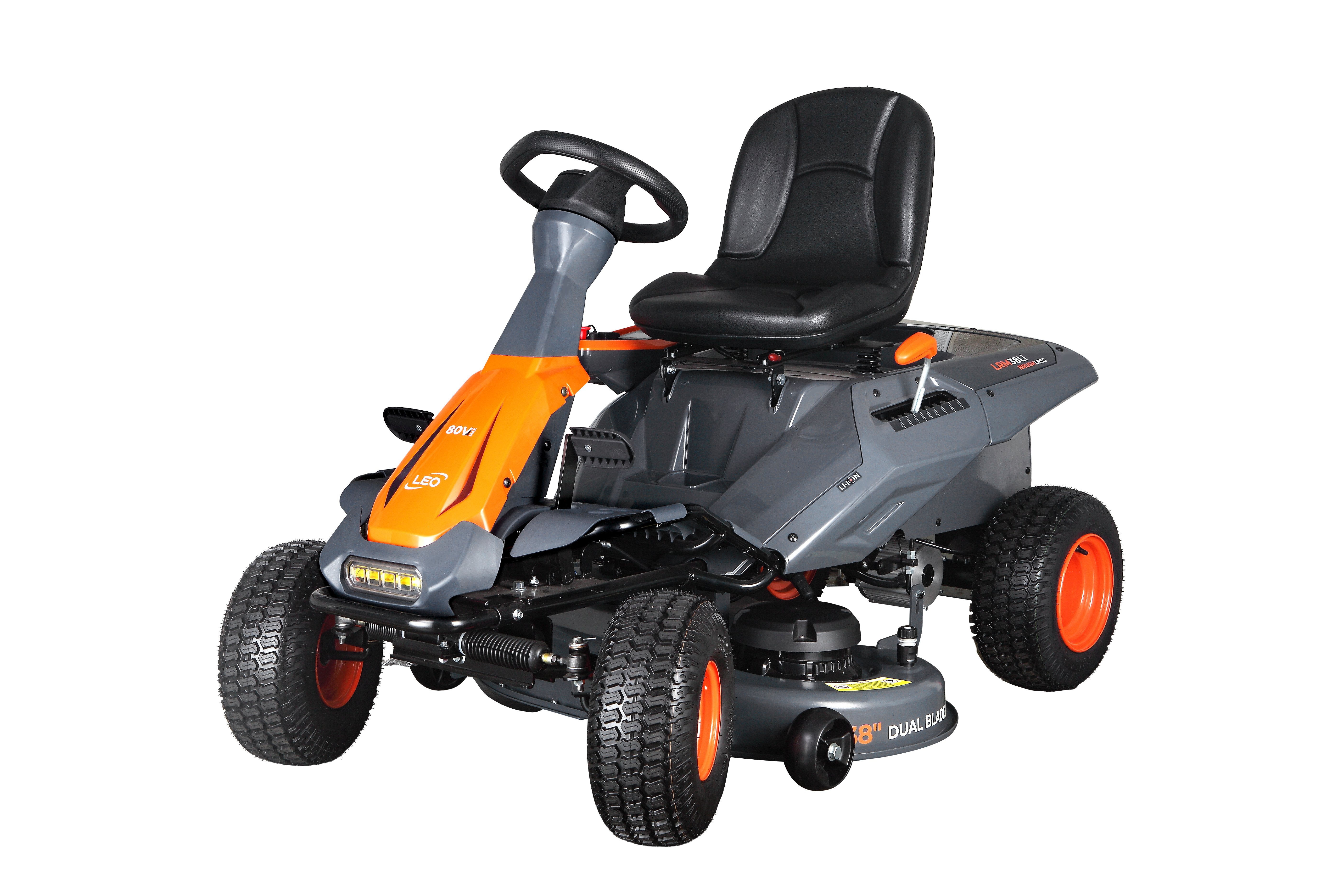
Long mowing days make vibration, exhaust heat and repetitive noise more noticeable. A lithium ion ride on mower can improve the working environment by avoiding engine exhaust and reducing the engine-related sound and vibration that operators associate with petrol equipment. That may support staff retention and concentration during professional landscaping work, especially where crews mow similar sites several days each week.
The real-world gain depends on the complete machine. Seat design, controls, suspension, turning space, slope limits and blade performance remain essential. A lithium ion ride on mower with poor access to charging or an awkward deck width will not become productive merely because it is electric.
Energy planning creates a clearer operating discipline
With a lithium ion ride on mower, energy planning becomes visible. Teams need to know the route length, grass conditions, travel time, expected cutting load and charging opportunities. That discipline has a useful side effect: supervisors have to assign equipment to a particular site instead of treating every property as the same mowing job.
Ask suppliers for model-specific information on usable runtime under representative conditions, charging time, battery warranty, permitted storage temperatures and service access. Then build a trial around your own grass height, terrain and transport routine. A lithium ion ride on mower that comfortably covers a short, predictable route may be an excellent fit; a machine expected to cover scattered large properties without a charging plan may not be.
Battery care is part of that discipline. Use the specified charger, keep charging areas suitable for the equipment and follow the maker’s instructions for storage and state of charge. Treat battery tools and ride-on equipment as controlled fleet assets, not as consumer devices that can be charged or stored without a process.
Where the total-cost case is strongest
The purchase price of a lithium ion ride on mower may be higher than that of some comparable petrol equipment, so the decision should not rest on acquisition cost alone. Assess the entire operating picture: energy cost, engine-service avoidance, expected battery support, transport, operator time, downtime exposure and the value of working more comfortably at sensitive sites.
A lithium ion ride on mower often makes the clearest business case when work is scheduled, charging is dependable and crews repeatedly visit similar properties. It is less certain for very remote routes, unusually heavy cutting, unmanaged slopes or operations that cannot accommodate charging pauses. In those cases, a mixed fleet can be more sensible than forcing one technology into every task.
A commercial evaluation checklist
- Map each candidate route before selecting a lithium ion ride on mower: acreage, grass condition, travel time and charging access all matter.
- Compare deck width and manoeuvrability with gates, trees, landscaped borders and trailer loading—not only with open-area productivity.
- Request written model-specific runtime, charging, warranty, safety and service information for the proposed lithium ion ride on mower.
- Set a battery charging, storage and inspection procedure for every crew using battery tools.
- Run a real route trial and record completed area, remaining charge, cut quality and operator feedback before fleet rollout.
Choosing the right fit for your fleet
The advantages of a lithium ion ride on mower are most meaningful when they solve a defined commercial problem: reducing local exhaust around customers, lowering on-site noise, simplifying engine-related maintenance or improving the daily experience for operators. Zhejiang Leo Garden Machinery Co.,Ltd manufactures garden machinery for markets including Europe and Central/South America, where distributors and contractors may need to balance these benefits against local service, specifications and site conditions.
There is no one-size-fits-all answer. A lithium ion ride on mower can be a compelling option for predictable, appropriately sized commercial routes with sound charging and service plans. Start with a route audit, validate the machine against real cutting conditions, and make the investment only when the total operating case—not a single headline benefit—supports it.

 Hot News