
 EN
EN
What Makes a Ride On Mower Comfortable for Long Working Hours?
A comfortable ride on mower is not simply one with a soft seat. During a long mowing session, comfort comes from how the seat, controls, foot platform, steering, suspension, visibility, and mower structure work together. If one part forces you to brace, reach, twist, or absorb repeated bumps, the benefit of the other parts quickly fades. That is why a sensible evaluation looks beyond upholstery and asks how the ride on mower feels over the actual ground you plan to cut.
After enough hours in the seat, small irritations become meaningful: a pedal that sits too far forward, a steering wheel that makes your shoulders rise, a seat that slides on a rough track, or a deck that makes it difficult to judge an edge. Good operator comfort is really fatigue management. The right ride on mower lets the operator sit in a neutral position, make routine adjustments with little effort, and maintain control as conditions change.
Start With the Seat, but Do Not Stop There
Seat quality matters because it supports the pelvis and back for the whole job. Look for a firm, shaped cushion rather than padding alone. A backrest with usable lumbar contour, adequate thigh support, and a stable seat base can make a ride on mower feel far less tiring over several hours. Adjustability is just as important: operators vary in height and leg length, so a fore-and-aft slide and practical seat angle adjustment help place the pedals and wheel within easy reach.
Suspension deserves a real test. Whole-body vibration reaches a ride-on operator through the seat and footrest, especially on uneven ground. A suspension seat can reduce some of that input, but it cannot compensate for excessive speed, hard tyres, damaged turf, or a poorly supported mower structure. Sit in the ride on mower, then drive it over the sort of bumps, ruts, and transitions that exist on your site. Notice whether the seat remains supportive or whether you begin to brace with your legs and lower back.
Armrests can help on longer runs when they support relaxed forearms without blocking steering or dismounting. They are useful only if their height and width suit the operator. A feature that forces elbows outward can be more distracting than helpful.
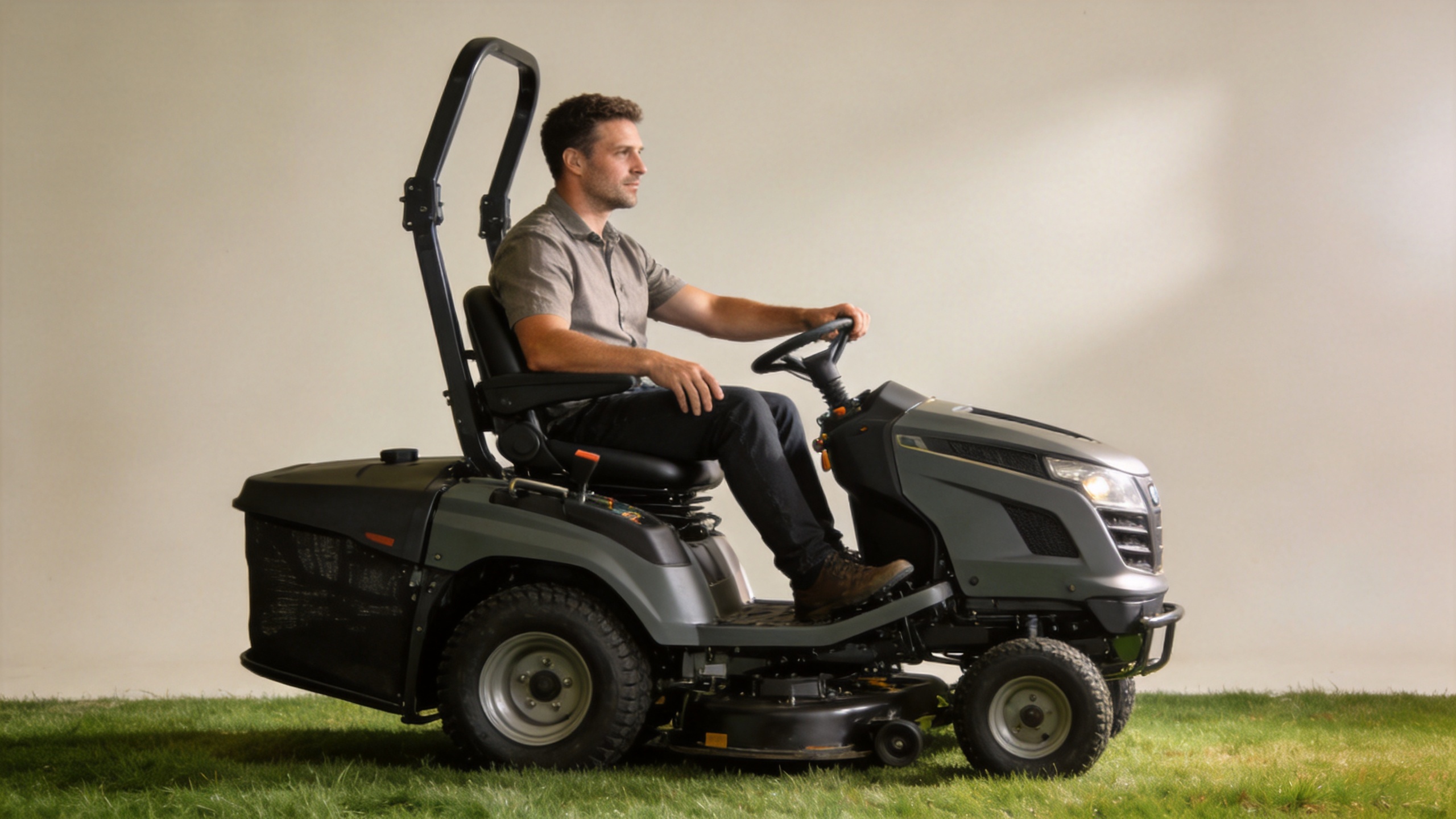
Ergonomic Design Keeps Controls Within a Relaxed Reach
Effective ergonomic design means the operator can reach the steering wheel, direction controls, deck-height lever, throttle, and safety controls without stretching or rotating awkwardly. Before buying a ride on mower, sit normally rather than leaning forward to “make it work.” Your shoulders should stay low, your elbows should retain a slight bend, and your feet should rest naturally on the platform or pedals.
Control resistance matters as much as location. A steering system that feels acceptable for five minutes may require noticeably more effort after repeated turns around trees, beds, and obstacles. The same is true of hydrostatic pedals, levers, and parking brakes. General lawn-mower ergonomics research points to lower force requirements and manageable grip spans as contributors to operator comfort. In practical terms, test how much hand and ankle effort the ride on mower demands while you turn, reverse, stop, and restart.
Clear labeling is part of usability, too. Operators should be able to identify common functions without taking their attention from the path for long. A tidy control zone reduces hesitation when the terrain changes or the machine needs to be stopped.
Foot Support, Leg Room, and Entry Matter More Than They Seem
A broad, non-slip foot platform gives both feet a stable place to work. On a ride on mower, the platform should allow comfortable changes in foot position without crowding the pedals or catching footwear on edges. Adequate leg room helps taller operators keep their knees relaxed, while sensible pedal spacing reduces the chance of pressing a control from an awkward angle.
Also check how easily you can get on and off. A low, open step area and secure handhold reduce repeated strain during a workday that includes gates, debris checks, refueling, or collection-bag handling. This is a useful reminder that operator comfort begins before the blades engage and continues after the last pass.
Mower Structure Determines How Bumps and Balance Reach the Operator
The mower structure influences stability, vibration, and confidence. Frame stiffness, wheelbase, tyre condition, chassis balance, seat mounting, and footrest support affect how the machine responds to rough ground. A compact ride on mower may be easier to store and maneuver, but its short wheelbase can feel more reactive on uneven areas. A larger machine may ride more steadily, yet it must still fit the gates, slopes, and turning spaces on the property.
Do not equate a large cutting deck or higher travel speed with better comfort. Search previews commonly describe lawn tractors with 42- to 54-inch decks and speeds around 6 to 7 mph, but comfortable operation depends on reducing speed when surface conditions demand it. If the operator is bouncing or gripping the wheel tightly, the appropriate response is usually to change pace or route—not to push through because the machine can travel faster.
Tyre pressure and maintenance also affect the ride. Follow the manufacturer’s guidance, inspect tyres for damage, and keep the deck, steering, and seat hardware in good condition. A well-designed ride on mower still loses much of its comfort when loose components, worn tyres, or poor adjustment introduce vibration and play.
Visibility and Mowing Workflow Reduce Mental Fatigue
Comfort is partly physical and partly cognitive. Good forward sightlines, a view of the deck edge where appropriate, and mirrors or a clear rearward view make it easier to place the ride on mower accurately. When an operator can see obstacles and judge overlap, there is less stop-start correction and less tension in the shoulders.
Consider how the machine behaves at the places that interrupt a normal mowing pattern: narrow turns, landscaping edges, slopes, reverse maneuvers, and transitions between grass types. A well-matched ride on mower should make these routine tasks predictable. If a control layout is confusing or the turning response feels abrupt, fatigue can build even when the seat itself is comfortable.
A Practical Long-Hour Comfort Test
A showroom check is useful, but a short supervised test on representative ground is better. Use this sequence when comparing a ride on mower:
- Set the seat and steering position, then confirm your feet reach the controls without locking your knees.
- Drive slowly over a rough section and note vibration through the seat, backrest, and foot platform.
- Make repeated left and right turns to assess steering effort and shoulder posture.
- Operate the direction, deck-height, and parking controls while seated normally.
- Check visibility at the deck edge, around obstacles, and when reversing according to the operating manual.
- Step on and off several times to assess access, grip, and clearance.
If possible, have every regular operator perform the same test. Operator comfort is personal: a ride on mower that suits one person’s reach and posture may not suit another’s.
Choose the System That Fits the Work
The most comfortable ride on mower is the one whose seat, ergonomic design, controls, mower structure, and usability fit the operator and the ground. Prioritize adjustable contact points, low-effort controls, stable foot support, sensible access, and a ride that remains composed at a safe working pace. Then maintain those features as carefully as you maintain the cutting system. That approach produces a more comfortable day in the seat and supports consistent, controlled mowing over the long term.
 Hot News