
 EN
EN
Why Are Petrol Lawn Mowers Still Popular in Commercial Applications?
For a landscaping business, mower choice is usually decided at the end of a long route, not at the start of a brochure comparison. A petrol lawn mower remains common because it lets a crew keep moving between uneven sites, heavier grass and changing schedules with a familiar service routine. Battery platforms have improved quickly and can be an excellent fit for quiet, tightly grouped work. Still, the petrol lawn mower has practical strengths when the day includes large areas, remote locations or little certainty about how long each job will take.
The useful question is not whether a petrol lawn mower is “better” in every situation. It is which tool leaves the fewest operational gaps for a particular crew. After working across dozens of client sites, the details that matter most are rarely the headline engine claim; they are access to fuel, cut conditions, transport space, downtime and who can service the machine before tomorrow’s first appointment.
Commercial work rewards continuity, not just cutting ability
On a residential route with short, predictable lawns, a cordless commercial mower may complete the work comfortably. On a scattered route, a petrol lawn mower can be easier to keep in service because refuelling is brief and portable. That does not make battery equipment inadequate. It means battery capacity, spare packs and charging windows must be planned as part of the route, while a fuel can and approved handling process can support a petrol lawn mower away from the depot.
Before choosing a platform, ask one question: how much of the crew’s day is spent where charging cannot happen? The answer often changes the decision. A landscaping business serving acreage, municipal edges, vacant properties or sites with no reliable power may value a petrol lawn mower for its ability to return to work after a refuel rather than after a charging interval.
This is a fleet issue as much as a machine issue. One mower that pauses unexpectedly can disrupt loading, handoffs and labour allocation. A professional equipment manager therefore compares the whole working system: machines, fuel or batteries, trailers, maintenance tools and the time available between jobs.
Demanding grass conditions still influence the choice
A commercial mower is asked to handle more variation than a lightly used domestic machine. Growth may be dense after rain, edges may be rough, and a crew may arrive after a client has postponed mowing. In those circumstances, the petrol lawn mower is valued for a familiar combination of sustained engine operation, wide availability of service parts and compatibility with established mowing practices.
Power alone is not the answer. Most petrol mowers in this class will handle ordinary conditions comfortably—well, most will, with the important caveat that blade condition, deck cleanliness, ground speed and cutting height often matter more than an engine label. A petrol lawn mower with dull blades or a clogged deck will not rescue a rushed job. The first time a crew attempts heavy growth immediately after wet weather, it may find that clumping and discharge management, rather than raw engine output, are the real constraint.
That is why operators assess a petrol lawn mower as part of a work method. They check whether the deck can be cleaned, whether the collection or discharge option suits the property, and whether the machine can be transported safely between calls. These are unglamorous details, but they protect finish quality and reduce rework.
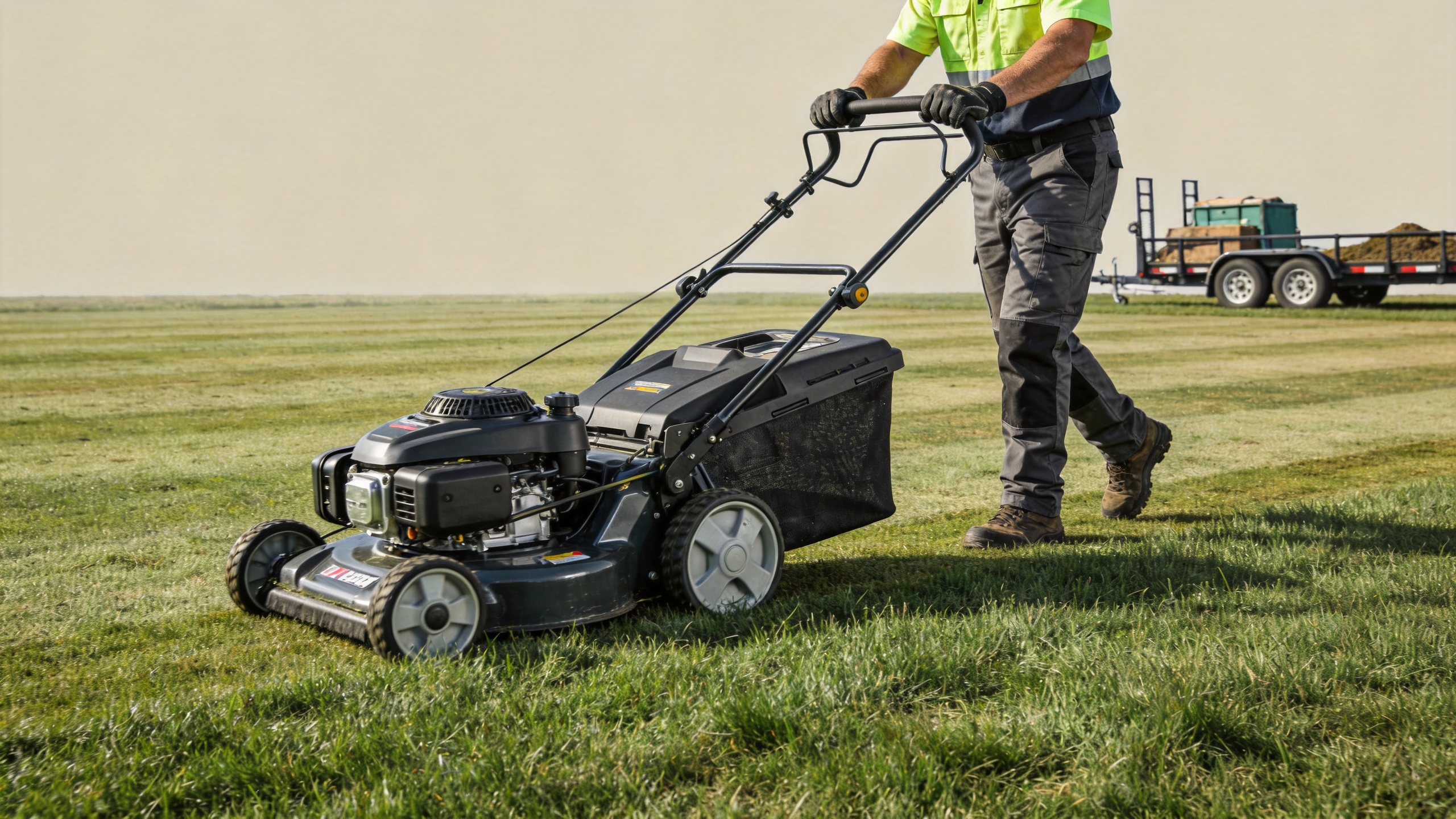
Existing service networks make petrol easier to manage
Commercial buyers rarely purchase garden tools as isolated items. They need a repeatable way to inspect, maintain and repair them. Many contractors already have technicians, local dealers or independent repair shops familiar with petrol engines. That familiarity can make a petrol lawn mower a lower-disruption choice when a fleet has established maintenance intervals and stocked consumables.
Routine care still matters: operators should follow the manufacturer’s instructions for fuel storage, oil, air filtration, blades and seasonal inspection. The advantage is not that a petrol lawn mower needs no attention; it is that the maintenance workflow is well understood in many markets. For a landscaping business, a predictable repair path can be more valuable than a small theoretical efficiency gain that is difficult to realize in the field.
Specialist garden machinery suppliers can also help distributors build a more coherent assortment across walk-behind mowers, ride-on equipment and related garden tools. That category depth is useful when customers need different machines for different sites rather than one technology for every job.
Petrol remains a practical option within a mixed fleet
The growth of cordless equipment should change purchasing conversations, not end them. Battery mowers can reduce local noise, avoid fuel handling and suit properties with predictable daily workloads. A petrol lawn mower may still be the sensible reserve or primary unit for longer shifts, remote work and tougher recovery cuts. Many professional equipment decisions are therefore about matching the platform to the route instead of choosing a single winner.
For example, a crew may schedule cordless units for schools, hospitality sites or noise-sensitive neighbourhoods, while retaining a petrol lawn mower for open grounds and work where charging logistics are less certain. This before-and-after approach replaces a one-size-fits-all fleet with a more deliberate division of jobs.
Compliance and operating rules cannot be an afterthought
Popularity does not remove responsibility. Petrol-powered non-road machinery is subject to evolving emissions and market-access requirements in many regions. In Europe, the Non-Road Mobile Machinery framework establishes emissions limits and approval procedures for engine classes and applications. Buyers should confirm the documentation, local restrictions and intended-use requirements for the exact petrol lawn mower and destination market rather than assume compliance from a category name.
Local noise rules, fuel-storage requirements and client policies may also narrow where a petrol lawn mower can be used. These factors are a reason to segment routes carefully, not a reason to make unsupported promises about any machine. A responsible supplier or buyer keeps current regulations and manufacturer documentation alongside the purchasing checklist.
A practical selection checklist for commercial crews
- Map site sizes, travel distances and access to charging or refuelling.
- Record typical grass conditions, including wet growth, slopes and collection needs.
- Compare the cost of downtime, not only the purchase price of a petrol lawn mower.
- Check local emissions, noise and fuel-handling rules before assigning equipment.
- Confirm dealer support, parts availability and maintenance responsibilities.
- Use cordless, petrol or both according to the work pattern rather than habit.
The bottom line
A petrol lawn mower remains popular in commercial applications because crews value mobile refuelling, familiar maintenance and the ability to adapt to long or unpredictable working days. It is not automatically the right choice for every site, and it should not be treated as a substitute for compliance planning. But where route continuity, service support and variable ground conditions matter, a petrol lawn mower continues to earn a place beside newer battery-powered professional equipment.

 Hot News