
 EN
How Does Battery Voltage Influence Cordless Lawn Mower Performance?
A cordless lawn mower can look simple on a shelf: select a battery, push the start button, and cut. Yet the voltage printed on the battery pack often creates more confusion than clarity. As a garden machinery technical consultant, I start with the lawn and workload rather than the largest number on the label. Voltage matters, but it is one part of a system that also includes motor design, battery capacity, electronics, blade condition, deck width, and the vegetation in front of the mower.
For a light weekly trim on a small, dry, level lawn, a modest platform may feel entirely capable. For long, damp, fast-growing turf or a self-propelled machine on a slope, the same cordless lawn mower needs more sustained electrical output. Understanding that difference helps you compare a voltage system without treating volts as a shortcut to every performance question.
Voltage is the pressure behind the electrical system
Voltage is often compared with electrical pressure. In a mower, it helps drive current through the motor and control electronics. Electrical power is expressed as volts multiplied by amps: power = voltage × current. A higher-voltage system can deliver a given amount of power with less current, or it can support a higher power level when the battery, wiring, controller, and motor are designed to handle it.
That does not mean a higher number automatically creates a more capable cordless lawn mower. The motor must convert electrical input into useful blade speed and torque, while the battery management system must permit the needed current. Two mowers with different labels can perform similarly in ordinary turf, and two tools on the same platform can behave differently because their motors, decks, and controllers differ.
Why mower power depends on more than the voltage system
When turf becomes taller, wetter, or denser, the blade encounters more resistance. The motor needs torque to maintain rotation rather than bogging down. A well-matched voltage system can help the mower meet that demand, but the available mower power comes from the complete electrical and mechanical design.
- Motor type and controller: Brushless motors and responsive controllers can adjust current delivery as load changes, using battery energy more effectively than a simple fixed-output arrangement.
- Battery current capability: Pack construction, cell condition, and temperature affect how much current the pack can supply under load.
- Deck and blade condition: A wide deck, a dull blade, or a heavily filled collection box adds load. Voltage cannot compensate for poor cutting setup.
- Self-propulsion: Driving the wheels consumes energy too, so a self-propelled cordless lawn mower has a different demand profile from a push model.
The number I kept checking was battery voltage. It took a while to realise that the torque available at the blade under a heavy patch of turf was the specification that mattered in practice. That is why a comparison should start with the work the mower must do, then examine the platform behind the voltage label.
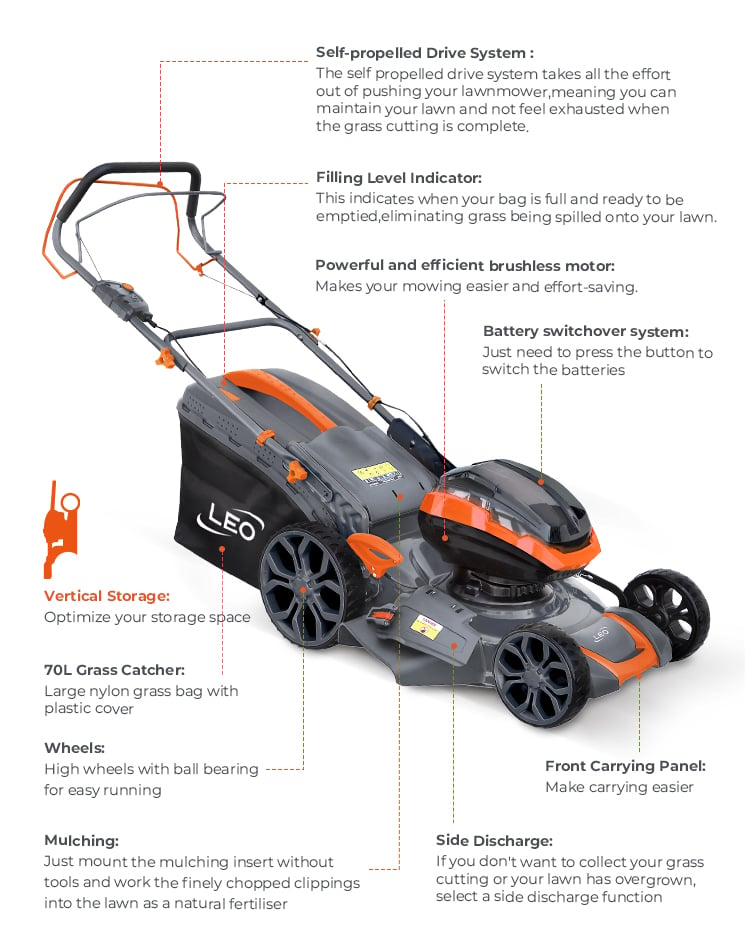 Battery voltage is one part of a mower’s combined power system.
Voltage, amp-hours, and watt-hours answer different questions
Battery technology uses several numbers, and each describes something different. Nominal voltage identifies the operating platform. Amp-hours (Ah) describe charge capacity. Watt-hours (Wh), calculated by multiplying nominal volts by amp-hours, give a more useful approximation of stored energy when comparing batteries across voltage systems.
| Specification | What it helps indicate | What it cannot tell you alone |
|---|---|---|
| Voltage (V) | How the battery platform and motor system are configured | Exact cutting torque, runtime, or cut quality |
| Capacity (Ah) | How much charge the pack holds within the same voltage system | Stored energy across platforms with different voltages |
| Energy (Wh) | Approximate usable energy for a broad runtime comparison | How efficiently a particular mower uses that energy |
| Current capability | Whether the pack can support demanding loads | Overall runtime or the quality of the cutting deck |
For example, do not compare two batteries only by Ah if their nominal voltage differs. Look at Wh, then allow for differences in cutting width, drive system, turf conditions, and control strategy. A larger energy reserve may extend runtime, but it also may add weight; the practical choice depends on the size and layout of the lawn.
What happens as the battery discharges
A battery is not equally responsive at every state of charge. Under a demanding cut, voltage at the terminals can dip temporarily as current rises. Heat, cold, battery age, and pack condition can also affect usable output. The mower electronics may reduce load or stop the tool before cells are over-discharged, which is a normal protection function rather than proof that the stated voltage system is inadequate.
This is where efficiency becomes useful. An efficient motor and controller turn more of the stored energy into blade work instead of heat. Keep the blade well maintained, clear the underside of the deck, avoid taking too much turf height in a single pass, and recharge using the manufacturer-specified charger. Those habits help a cordless lawn mower stay consistent across a mowing session regardless of the number printed on the pack.
Match the voltage system to the lawn, not the marketing shorthand
Small, maintained lawns
If your lawn is small, reasonably flat, and cut regularly, a compact battery platform can be a sensible choice. Prioritise manageable weight, a battery with enough watt-hours for your usual session, and a deck width that suits tight paths and storage space. More voltage is not automatically more useful if the mower is already completing the job comfortably.
Medium lawns with mixed turf conditions
A medium lawn often benefits from a platform that combines a capable motor with one or two batteries sized for the actual area. Look for clear runtime guidance that states the test conditions, and consider whether you will cut after rain or allow turf to grow longer between sessions. In this range, the relationship between mower power, battery energy, and deck load matters more than a single voltage claim.
Large, uneven, or frequently overgrown lawns
For demanding ground, assess the complete duty cycle: cutting width, drive assistance, extra batteries, charge turnaround, turf density, and slope. A higher-voltage platform may be appropriate when it is paired with a motor, controller, and battery pack designed for sustained work. Still, if the property is very large or routinely overgrown, plan the job realistically rather than assuming any cordless solution will fit every workload.
A practical checklist before choosing a cordless lawn mower
- Measure the lawn and note slopes, narrow sections, and obstacles.
- Decide how often you cut and how tall or damp the turf commonly is.
- Compare battery energy in watt-hours, not voltage or amp-hours in isolation.
- Check the motor, cutting width, drive arrangement, and supplied battery count together.
- Ask whether additional packs and chargers fit the same battery technology platform.
- Maintain the blade and cutting deck so available power is used for vegetation rather than friction.
The bottom line
Battery voltage influences how a cordless lawn mower is engineered to deliver power, especially when the mower encounters a heavier cutting load. It is not a stand-alone rating for speed, torque, runtime, or cut quality. Compare the full voltage system: stored energy, current capability, motor and controller design, deck load, and the lawn you need to maintain. With that approach, you can select a mower whose performance matches real garden conditions rather than a headline number alone.
 Hot News